
Affichage des articles dont le libellé est google. Afficher tous les articles
Affichage des articles dont le libellé est google. Afficher tous les articles
jeudi 31 mai 2012
How Do You Cultivate Innovation ?
Being innovative means solving a problem in a unique and creative
way. Companies like Google, Apple, GE and Facebook have made billions
because innovation is a principal value in everything they do. Given the
positive associations with it, every organization likes to think it
fosters innovation, but unfortunately, the truth is often much
different. This week's Culture Beat explores the qualities of truly
innovative cultures. How does yours stack up?
Promoting Pride in the Individual and the Organization
According to research recently published in the Journal of Business Venturing, which looked at two decades of data on 62 countries, both individualistic and nationalistic cultures support innovation. While it’s not a major surprise that individualism is strongly associated with innovation, a more intriguing finding is that cultures that value the success of the group and have high degrees of patriotism also encourage innovation in their people. Countries like Japan and Sweden, for instance, are traditionally more collectivist but are also extremely innovative.
Employing Transformational Leadership
Transformational leadership is a management style that seeks to positively impact the attitudes and behaviors of followers. Frequently described as high-energy and high on passion, transformational leaders are focused more on success of the people responsible for the outcome than the success of the outcome itself. Such managers promote intellectual curiosity, open communication, performance rewards and professional development. They are able to articulate a clear vision for progress and, by appealing to the moral high ground, serve as an inspirational role model for employees. Michael Dell of Dell, Jeff Bezos of Amazon, Lou Gerstner of IBM and Martin Luther King Jr. are oft-cited examples of transformational leaders.
Giving People Permission to Fail
True innovators know that hitting upon a successful idea is a process of trial and error, and more often than not, you have to experiment with several approaches before finding one that works. Cultures infused with innovation are not risk-averse and don’t hold people back by always insisting on a revenue-winning outcome. By giving employees the freedom to fail, organizations also open themselves up to spectacular wins. Sounds a bit like transformational leadership, doesn’t it? And one need only to look at Microsoft to see it in action.

Don’t Restrict the Focus to R&D
Throwing some budget at research and development departments, or launching a siloed “innovation committee” will not definitively move your culture in the right direction. Instead, employees in all areas of the business must be encouraged to weave innovative thinking into everyday tasks and projects, and should be rewarded for doing so.
Innovative Cultures Don’t Need Gatekeepers
Fast Company Co.Design bloggers Jens Martin Skibsted and Rasmus Bech Hansen claim that there is a new type of professional in American businesses specifically tasked with innovation. “Innovation custodians” are middle managers assigned to oversee innovators and their processes. “Innovation word-slingers” are external consultants who lead in-house innovation workshops. The problem with innovation professionals, say Skibsted and Hansen, is that they rarely have the maverick outlook that it takes to innovate in a substantive way. Also, innovation should be an attitude that organically runs through the heart of an organization and cannot be easily implemented by a manager with a to-do list.
Do you think your culture breeds innovation? What advantages and disadvantages do small businesses have in this regard?
Alexandra Levit is a former nationally syndicated business and workplace columnist for The Wall Street Journal and the author of Blind Spots: The 10 Business Myths You Can’t Afford to Believe on Your New Path to Success. Money Magazine’s Online Career Expert of the Year, she regularly speaks at organizations and conferences on issues facing modern employees.
Promoting Pride in the Individual and the Organization
According to research recently published in the Journal of Business Venturing, which looked at two decades of data on 62 countries, both individualistic and nationalistic cultures support innovation. While it’s not a major surprise that individualism is strongly associated with innovation, a more intriguing finding is that cultures that value the success of the group and have high degrees of patriotism also encourage innovation in their people. Countries like Japan and Sweden, for instance, are traditionally more collectivist but are also extremely innovative.
Employing Transformational Leadership
Transformational leadership is a management style that seeks to positively impact the attitudes and behaviors of followers. Frequently described as high-energy and high on passion, transformational leaders are focused more on success of the people responsible for the outcome than the success of the outcome itself. Such managers promote intellectual curiosity, open communication, performance rewards and professional development. They are able to articulate a clear vision for progress and, by appealing to the moral high ground, serve as an inspirational role model for employees. Michael Dell of Dell, Jeff Bezos of Amazon, Lou Gerstner of IBM and Martin Luther King Jr. are oft-cited examples of transformational leaders.
Giving People Permission to Fail
True innovators know that hitting upon a successful idea is a process of trial and error, and more often than not, you have to experiment with several approaches before finding one that works. Cultures infused with innovation are not risk-averse and don’t hold people back by always insisting on a revenue-winning outcome. By giving employees the freedom to fail, organizations also open themselves up to spectacular wins. Sounds a bit like transformational leadership, doesn’t it? And one need only to look at Microsoft to see it in action.
Don’t Restrict the Focus to R&D
Throwing some budget at research and development departments, or launching a siloed “innovation committee” will not definitively move your culture in the right direction. Instead, employees in all areas of the business must be encouraged to weave innovative thinking into everyday tasks and projects, and should be rewarded for doing so.
Innovative Cultures Don’t Need Gatekeepers
Fast Company Co.Design bloggers Jens Martin Skibsted and Rasmus Bech Hansen claim that there is a new type of professional in American businesses specifically tasked with innovation. “Innovation custodians” are middle managers assigned to oversee innovators and their processes. “Innovation word-slingers” are external consultants who lead in-house innovation workshops. The problem with innovation professionals, say Skibsted and Hansen, is that they rarely have the maverick outlook that it takes to innovate in a substantive way. Also, innovation should be an attitude that organically runs through the heart of an organization and cannot be easily implemented by a manager with a to-do list.
Do you think your culture breeds innovation? What advantages and disadvantages do small businesses have in this regard?
Alexandra Levit is a former nationally syndicated business and workplace columnist for The Wall Street Journal and the author of Blind Spots: The 10 Business Myths You Can’t Afford to Believe on Your New Path to Success. Money Magazine’s Online Career Expert of the Year, she regularly speaks at organizations and conferences on issues facing modern employees.
12:49 1
mercredi 30 mai 2012
If The Spec Is Dead So Is The Nexus Tablet

Besides, even without the compatibility issues (which might be resolved), Google will not be able to launch a wireless-enabled tablet at a Kindle Fire price. They can’t in essence eat their Jelly Bean and have it too.
Much like the so-called spec, performance is dead. It’s meaningless in today’s post-PC devices. Either the device, such as a tablet, works, or it does not. A quad-core chip like the Tegra 3 used here does not improve Angry Birds. There is simply an expectation by the consumer that a device works, and if it does not, then it’s worthless. Comparing clock speed or data throughput between different modern SoCs is worthless. Consumers are shopping for functionality rather than performance. A Nexus tablet without 3G/4G is doomed to the niche market.
Google recently started selling unlocked Galaxy Nexus smartphones from the Google Play storefront. This in theory could also work for wireless tablet. For whatever reason Android tablets with wireless connectivity are strangely tied to 2 year wireless data contracts. This makes them horrible buys compared to the iPad that’s sold with just an extra surcharge for the option. Not only do these tabs generally carry a similar price, but they lock buyers into a 2-year contract that greatly inflates the overall cost. In a perfect world Google would bypass the carriers, and sell an unlocked Nexus tablet in this same storefront — expect a WiFi model to be available there, though.
The Nexus brand has always been a sort of geek device, targeting Android’s core audience rather than the general consumer. Even the name, a nod to Blade Runner, is an inside joke among its users. But a Nexus Tablet is supposed to be something different. It’s supposed to be a Google’s answer to the iPad and the Kindle Fire.
Ignoring different platforms, the iPad and Kindle Fire hold a dominant chunk of the total tablet marketshare. For various reasons pure Honeycomb tablets do not sell in overwhelming numbers. Simply put, most of the Android tabs from Samsung, Motorola and Asus are priced similarly to the iPad and do not offer a significant advantage. The Kindle Fire is different, though.
Amazon got the Kindle Fire right. By pricing it at $200 and skinning it with a consumer-friendly GUI, the tablet targeted the huge audience of curious onlookers. It didn’t need 3G wireless to sell versus the iPad. The low price was justification enough.
Amazon wisely built the tablet around its robust content offering, allowing the retailer to sell the tablet with a very slim margin. Traditional tablet makers like Samsung and Motorola do not have this luxury. These consumer electronic companies need to turn a profit from the hardware. Amazon, and Apple for that matter, can rely on retail channels to make up for the smaller margins on the device itself.
Google is going to have the same problem with the Nexus tablet. It’s unclear if Google Play can provide enough back-end revenue to support a low price for the Nexus Tab. It’s rumored to retail for $199 to $249, providing a Honeycomb (or even Jelly Bean) alternative to the Kindle Fire. Today’s rumor peg the device with a top-of-the-line Tegra 3 SoC and a quality screen. These are not inexpensive parts like Amazon uses in the Kindle Fire. Samsung sells its less capable Galaxy Tab 7.0 for $349. But without wireless connectivity, the only advantage Google has will be price. Without a low price and wireless connectivity, the Google Nexus Tablet will be just another also-ran Android tab.
11:09 1
Microsoft Launches Office 365 For Government

Google touted its ISO 27001 certification for Google Apps for Business last week, which Office 365 for Government also qualifies for. Just like its predecessor, the Business Productivity Online Suite Federal, Microsoft’s new service also supports a plethora of other certifications, including SAS70 Type II, the US Health Insurance Portability, Accountability Act (HIPAA) and the US Federal Information Security Management Act (FISMA). Microsoft also plans to support Criminal Justice Information Security policies soon. The service will soon offer support for IPv6 as well.
The major difference between Microsoft’s enterprise solution and this government cloud is that the government data lives on its own segregated infrastructure. Besides this – and the additional certifications – Microsoft’s government solution includes virtually the same services as the enterprise version, including Exchange Online, Lync Online, SharePoint Online and Office Professional Plus. Given that Microsoft’s enterprise solution is also now FISMA certified, this new service is mainly meant for agencies that have requirements beyond this certification.
11:05 1
Google+ Local Unlocks the Power of Zagat

The new “Local” tab, located on the right-hand side of Google+, encourages users to learn more about the places around them. For example, by searching for a restaurant or store through the tab, a Google+ page will appear with photos, as well as Zagat scores and summaries, reviews from people you know and other information such as addresses and hours of business.
“This takes any place that your friends have touched and provides you with interesting and relevant search results,” Avni Shah, director of product management at Google, told Mashable. “You can also filter based on aspects that might be important, such as ‘People Like You’ and really give you the information you need from the people you trust.”
When logged in to Google+, this information will appear in Google searches and via Google Maps and mobile. The capability is only available for Android phones now, but Google said it will roll out to iOS devices soon.
Those not signed in to Google+ will still see Zagat reviews and recommendations pop up while doing a search, but only users who are signed in will gain a deeper look at where their friends like to dine or restaurants that might be a best match for your taste.
“Since your friends haven’t always been to the places you want to go, if you are going to London or Bangkok, Google+ Local will look at places you have rated highly before and make similar recommendations,” Shah said.
Want to make a reservation after oogling your friends’ favorite spots? You can do that too, thanks to Google+ Local’s integration with Open Table.
“We want to build a community based on a sense of trust, and we will continue to roll out new features and tools that reinforce that that concept,” Shan said.
10:33 1
vendredi 11 mai 2012
Why Microsoft Is Being Left in the Dust

There are now a number of companies — Apple, Google, Amazon, and others — that have Microsoft in their rear-view mirrors, disappearing quickly on the horizon in a cloud of dust.
That kick of dust in the company’s face is being emitted by Apple’s iPhone and iPad, Amazon’s Kindle, and Google’s search and cloud domination. Microsoft’s own wild lunges into various technology segments are also contributing considerably to it being left behind. Take the company’s recent partnership with Barnes & Noble, where it took 18% of the Nook e-reader for $605 million in cash and future guarantees. This was a move to compete with Amazon, but can it really compete?
If you want to know why Microsoft’s share price has been flat for 11 years while Apple, Amazon, and Google shares have soared, this is why. Microsoft is not innovating aggressively. It is not leading categories or blazing trails. No, it’s acquiring aggressively as a shortcut to innovation. That isn’t working. Its own history suggests as much.
Microsoft Has Not Capitalized on its Partnerships and Acquisitions
Last year, Microsoft announced a broad strategic partnership with Nokia, presumably to use Windows operating systems and software on Nokia’s smartphones. This was 15 months ago. But last week, a report found that Apple and Samsung generated 99 percent of the profits in the mobile phone category. Nokia, which once enjoyed more than half of all mobile phone profits, made zero.
In 2009, Microsoft acquired a 10-year license to use Yahoo’s core search technology, which later became the Bing search engine. Today, Google’s search market share is a dominant 66%, with Microsoft’s Bing a very distant second at 15%. After spending billions building and marketing Bing, Microsoft is barely visible in Google’s rear-view mirror.
Finally, what of Microsoft’s Skype acquisition a year ago? It’s too early to tell, but here’s a fact worth noting: The Wall Street Journal reports that 85% of Microsoft’s revenue comes from Windows and Office software. The rest of it? Barely a blip.
And so, Microsoft is proving, like many have before it, that acquiring companies outside your core competencies are recipes for failure. Remember when Cisco purchased the Flip video camera, at the time one of the most popular consumer electronics products on the planet? How did that work out? In 2010, HP bought Palm for $1.2 billion, but we haven’t seen any industry-altering smartphones from HP.
Conversely, consider Apple’s acquisition of Siri: a technology that immediately and profoundly complimented and enhanced its iPhone. It fit obviously and very successfully.
Microsoft Does Not Need to Compete with Amazon
Another major problem with Microsoft’s partnership involving the Nook is that there is simply no need for it to compete with Amazon. This is like Best Buy focusing all of its efforts on its ecommerce site while neglecting its one major competitive advantage: its brick-and-mortar stores. This is also like Research in Motion spending a year building its atrociously received tablet, the PlayBook, while neglecting its core competency of Blackberry smartphones.
Microsoft dominates the competition in computer operating systems and software. Computers are dying, right? And yet, in May 2012, there is no Microsoft Office for tablets and smartphones. Millions of iPads and Android tablets are being adopted in corporate environments, and most of those customers would be happy to spend $70 on Microsoft Office for each device. Except, it does not exist.
I can only guess why: because with its many categories, acquisitions and partnerships, Microsoft is physically incapable of putting its full focus behind converting its desktop products to mobile devices.
Microsoft is Going Wide, Not Deep
Which brings me to the third and final big problem with Microsoft’s Nook play. It is keeping with the strategy of going as wide as possible. Microsoft is not, and cannot be, all things to all people. In fact, no company can.
Here’s the truth: The wider you go, the more priorities you focus on, the less chance you have to be successful. But when you go deep, you can dominate. (See Apple, and Amazon.) When you go deep, you can continue perfecting. You become the world’s expert on a certain specialty. Apple is seen as the world’s expert on smartphones and tablets. Amazon is the accepted leader in online shopping and electronic reading. It’s because these two companies relentlessly focus on their strengths, saying no to nearly everything else. No. That’s a word Microsoft should consider trying out before it gets left in the dust permanently.
12:05 1
mercredi 2 mai 2012
Bing Takes on Google With Simple New Design
Microsoft’s search engine Bing
has done some heavy spring cleaning as a part of an effort to
de-clutter its search result pages — and the new design looks a lot like
Google.
Bing rolled out a new look that is designed to help users get results faster than ever. But the seamless design bears a striking resemblance to Google Search’s simple layout. See below.
 “Over the past few months, we’ve run dozens of experiments to
determine how you read our pages to deliver the link you’re looking
for,” Sally Salas, principal group program manager at Bing, said on its official blog.
“Based on that feedback, we’ve tuned the site to make the entire page
easier to scan, removing unnecessary distractions, and making the
overall experience more predictable and useful.”
In addition to faster page-load times and more relevant search results, Bing tightened the header and removed the “left rail” related-search section, making it easier to find the information and links you want.
It also enlarged the space between lines to increase readability and optimize the page for touch devices.
Bing said it is working on updating its search page even more in the future.
“We’re not finished, ” Salas wrote. “Today, we’re also testing out some new ideas for the homepage, including a larger version of the popular daily image. If you happen upon the homepage changes, please let us know what you think.”
What do you think of Bing’s new search results page? Do you think the site looks too much like Google? Let us know in the comments.
Bing rolled out a new look that is designed to help users get results faster than ever. But the seamless design bears a striking resemblance to Google Search’s simple layout. See below.
In addition to faster page-load times and more relevant search results, Bing tightened the header and removed the “left rail” related-search section, making it easier to find the information and links you want.
It also enlarged the space between lines to increase readability and optimize the page for touch devices.
Bing said it is working on updating its search page even more in the future.
“We’re not finished, ” Salas wrote. “Today, we’re also testing out some new ideas for the homepage, including a larger version of the popular daily image. If you happen upon the homepage changes, please let us know what you think.”
What do you think of Bing’s new search results page? Do you think the site looks too much like Google? Let us know in the comments.
12:28 1
mardi 1 mai 2012
Could Project Glass and a New CMOS Bring Real X-Ray Glasses?

The prototype we've seen is an unobtrusive, side-mounted display, but we can envision the technology being someday embedded into more traditional-looking glasses -- though the prototype doesn't look all that bad.
But all that is "old news" that you've heard about before. What you might not have heard of is a new CMOS sensor that's been developed in Texas.
In this context, a CMOS sensor is a Complementary metal–oxide–semiconductor specifically designed for capturing light and converting it into a digital picture file. Pick your chin up off the floor! The technology isn't new, you've got one of these newfangled CMOS doohickies inside your phone right now -- maybe even two of them: it's your digital camera.
At the University of Texas in Dallas, Dr. Kenneth O, a chaired professor of electrical engineering, and his team have come up with a CMOS chip that utilizes a range of the electromagnetic spectrum that hasn't been used before. It can see "light" that exists somewhere between the infrared and microwave wavelengths, in the terahertz spectrum.
"We've created approaches that open a previously untapped portion of the electromagnetic spectrum for consumer use and life-saving medical applications. The terahertz range is full of unlimited potential that could benefit us all.
"CMOS is affordable and can be used to make lots of chips. The combination of CMOS and terahertz means you could put this chip and receiver on the back of a cellphone, turning it into a device carried in your pocket that can see through objects."
Yup, you read that correctly! Using this CMOS sensor you can see through stuff! Some examples of it's use include being able to inspect the insides of walls (plumbing, electrical, structural, etc.), identify counterfeit money, and even scan for tumors inside the human body.
Let's add an extra CMOS sensor to the Project Glass appliance (is that what we should call it?), and now you can wear your fancy new camera that can see through objects.
Wait a minute! Didn't I see an ad for this kind of glasses in the back of a magazine when I was a kid?

Yes, that's right! Using a terahertz-style CMOS sensor, one could
theoretically see through clothing, and into bathroom and changing-room
stalls. Since this technology exists in a CMOS sensor, saving the image
(whether in a still picture or a video file) wouldn't be difficult. The
technology exists today.
Before you grab your pitchforks and torches, it's not very likely that this technology will make its way into our phones, let alone a newfangled set of glasses. Not for a while anyway.
However, if it's done in the name of "security" you could very well see a pair of these glasses being worn by law enforcement officials trying to "keep us safe" by seeing who might be carrying "weapons". Then again, they might be checking out the bikini team that's getting on the subway, too.
09:23 0
samedi 28 avril 2012
Yahoo Escalates Patent War With Facebook

The company also accused Facebook of not having a good-faith belief in the counterclaim it filed almost a month ago.
“Today Yahoo! filed additional claims against Facebook in U.S. District Court related to two additional patents on which Facebook infringes,” Yahoo said in an emailed statement.
“As we have stated previously, Yahoo!’s technologies are the foundation of our business that engages over 700 million monthly unique visitors and represent the spirit of innovation upon which Yahoo! is built. We intend to vigorously protect these technologies for our customers and shareholders.”
In the face of the new claims, Facebook was more succinct: “We remain perplexed by Yahoo’s erratic actions,” a Facebook spokesperson said, also in an emailed statement. “We disagree with these latest claims and we will continue to defend ourselves vigorously.”
With the “erratic” dig, Facebook seems to be depicting Yahoo as the tech-company equivalent of a crotchety old man. Considering Yahoo specifically calls out Facebook for using recently acquired patents as the basis of its lawsuit — even though some of the patents in Yahoo’s claim were acquired as well — the image may well stick.
A quick recap: Shortly after appointing former PayPal executive Scott Thompson as CEO, Yahoo warned Facebook that the social network was infringing on its intellectual property — specifically, 10 patents that relate to Internet technologies.
It then went ahead and sued Facebook a few weeks later, becoming something of a tech-industry pariah in the process.
Facebook, rather than try to end the suit with a quick settlement, set out to arm itself for a retaliatory strike. The social network quickly acquired many patents from both IBM and Microsoft. Facebook also countersued Yahoo — saying that it, too, was guilty of patent infringement.
The whole affair would be funny if it wasn’t a symptom of a wider, all-out patent war. In the last year we’ve seen Apple, Google, Microsoft and a host of others sue the pants of each other, and a company that barely does anything can claim to hold a patent on the web itself.
So this latest salvo in the Facebook-Yahoo patent war likely won’t be the last. What’s your take on the ongoing dispute? Sound off in the comments.
10:32 2
mardi 10 avril 2012
Today: UN Secretary General Ban Ki-moon Hosts a Google+ Hangout

The event will be moderated by Google’s David Drummond, and like previous Hangouts will likely consist of the moderator and the other selected participants having their turns to ask the guest pre-screened questions.
You can connect with the UN on Google+ here and ask a question, although it seems like the people who will be in the Hangout have already been chosen.
The Hangout will be streamed at youtube.com/unitednations. Check out a video highlighting the event below.
10:35 0
Everyone’s Curious About Instagram; Android App Hits 5 Million Downloads

As reported first by The Next Web, by studiously watching the Google Play page for the Instagram app, the app has now jumped into the category of “5,000,000 – 10,000,000″ installs where it was previously in the “1,000,000 – 5,000,000″ install range. I’ve picked up the application myself, and while I still think it’s a close call with Camera ZOOM FX, Instagram’s ability to auto upload and share with others is pretty slick.
Are you using Instagram for Android?
10:32 1
lundi 5 mars 2012
Google Brings Location Search History to Mobile Browsers

If you've got Google's Web History enabled, letting it keep track of your queries, it's now going to pay special attention to the details on any physical places you end up searching for. Later on, when you pull up Google on your phone's browser, you'll be able to review those locations through a new "Recent" icon. Unlike Chrome to Phone, there's no special software to install on either side of this equation; you just need to be logged-in to Google on your phone with the same credentials you use on your PC.
For now, the new feature works on Google's Android browser and with Mobile Safari on iOS.
15:14 0
dimanche 4 mars 2012
One Year Later: How Google Panda Changed Our Business
Editor’s note: Matt Moog is the founder and CEO of Viewpoints.com.
Google Panda strikes
February 24, 2011 was a day that will live in infamy for the team here at Viewpoints. That was the day of the Google Panda update. Up until that point we had enjoyed four years of consistent traffic growth to Viewpoints.com. We managed to double traffic each year and had just reached 2.7 million unique users. We had heard that Google was planning to update its algorithm to penalize content and link farms and were excited about the bump we might get as a result. Turns out we were in for a bit of a surprise.
Viewpoints takes it on the chin
You see, Viewpoints is a consumer reviews and product ranking web site. We have 600,000 reviews of 100,000 products contributed by more than 250,000 members. We have had more than 70 million visits to the site since we launched in late 2007. All of our content is original and we always viewed all of our practices as the “right way” to do things. Apparently Google felt differently because we lost 50% of organic search traffic overnight as a result of the Panda update.
And tries some quick fixes
As the days passed and we sorted out all of the comments from Matt Cutts and industry pundits and watched the Google blog as anxiously as the faithful await the plumes of smoke from the Vatican to figure out what we could do to get back in the good graces of the Google crawler. Was it our ad density? Was it speed of our site? Did we not have the right authoritative back links? Was it that some of our reviews were short and Google was penalizing sites with ”thin content”?
The truth of the matter was that it could have been any and all of these. Although we had hundreds of thousands of great reviews, we had probably let some slip through that did not deserve to be published. And we had not paid enough attention to speed, ad density or other hall marks of a good user experience. So we set out to fix our Google problem but at the same time, we resolved to think bigger and longer term and use this opportunity to create a better user experience, regardless of what Google was looking for.
So now you can judge the results for yourself. We have spent the last 12 months as a team of 25+ professionals reinventing Viewpoints. From March to June we removed 40% of the ads across the site. We improved the speed of the site by 3x. We moderated out 80,000+ reviews that did not meet minimum quality standards. Unfortunately these changes had only a nominal impact on traffic. So we decided it was time for a more radical approach.
Time to make serious long-term changes
After making the changes listed above and 90 days after Google’s Panda update, our team decided to devote six months to a total overhaul of the Viewpoints.com user experience. This was not just a visual redesign but a soup-to-nuts, top-to-bottom overhaul. We ended up making 30 major changes to the user experience. This entire effort was basically a bet the company decision. It had been four years since we first launched and the reality is that the world had changed. It was time to question even some of the most fundamental assumptions.
Content Quality – addressing the perception of “thin” content
In addition to eliminating 80,000 reviews that did not meet our new quality standards we also decided to eliminate stand alone review pages for all but the longest reviews. This one decision removed 600,000 pages from the site. We also decided to treat very short reviews differently. A new minimum threshold was established for when a review would become publicly accessible. If you want to review a product and say “It’s awesome!” that’s fine, we just don’t think your two word review helps other consumers enough to warrant publication. We also made the tough decision to exit more than 300 review categories that had more than 90,000 reviews. We decided strategically to focus on product reviews and retire hundreds of non product review categories such as hotels, restaurants and movies. All of these decisions to improve content quality together eliminated 20% of all reviews and completely eliminated short review pages in favor of very comprehensive product pages.
We don’t know if Google will notice, but we do feel that we have addressed the issue of “thin” content the best that we can.
Site Credibility
In addition to eliminating “thin content” we also focused on the overall credibility of a site. Google suggested that site owners need to put themselves in the shoes of users and ask the question “Would I trust this site with a health issue or my credit card?”
For Viewpoints, this meant cleaning up the content as outlined above as a first step, but it was also time for a redesign that was cleaner, simpler and better conveyed the credibility, quality and overall helpfulness of the site. In addition to eliminating 40% of the ads on the site, we also stripped out 15+ features that were clouding the core value proposition of consumer reviews and product rankings. For example, we made the decision to stop giving scores to products that did not have enough reviews. And we made it clear when members had connected their account to Facebook to demonstrate an extra layer of authenticity of the reviewer. You can see the following screen shots for some examples of the old design and the new.
OLD SEARCH RESULTS

NEW SEARCH RESULTS

OLD PRODUCT PAGE

NEW PRODUCT PAGE

Product Intelligence
So we have addressed content quality, site architecture and site credibility. But were we adding enough value to distinguish ourselves in a crowded market? Good question! While we firmly believe that getting the basics right (quality, credibility, ease of use etc) is the key to a great consumer reviews user experience, it became clear to us that there was another important way we could distinguish the Viewpoints user experience. We saw an opportunity to occupy the white space between expert reviews that make clear buy recommendations and the mass of consumer reviews which gave great consumer feedback but did not always help give a clear and concise buy recommendation.
We call this “Product Intelligence – for the consumer by the consumer“. We have spent a significant amount of time and resources developing scoring and ranking algorithms to smartly rank products against each other so that shoppers know what product to buy.
Diversification
As much as these changes were done to improve the user experience and in turn improve our rankings with Google, we also explicitly wanted to optimize mobile and social as two new channels that can be a new source of growing traffic to help us build our audience. The changes we made in these areas were very significant. The specific changes will be detailed in a later post.
Conclusion
So, that is how Google’s Panda update changed our business. It drove us to improve the quality of content, improve the credibility and trust of our experience and invest in Product Intelligence as a distinct point of difference in the market.
We don’t know how Google is going to respond to these changes but the important thing to note is that every change we made improved the experience for the user. So as disappointed as we were with the outcome of Panda, we will admit that it forced us to think harder about our business, about adding more value to the end user, and perhaps most importantly, take our game to another level. Game on.
Google Panda strikes
February 24, 2011 was a day that will live in infamy for the team here at Viewpoints. That was the day of the Google Panda update. Up until that point we had enjoyed four years of consistent traffic growth to Viewpoints.com. We managed to double traffic each year and had just reached 2.7 million unique users. We had heard that Google was planning to update its algorithm to penalize content and link farms and were excited about the bump we might get as a result. Turns out we were in for a bit of a surprise.
Viewpoints takes it on the chin
You see, Viewpoints is a consumer reviews and product ranking web site. We have 600,000 reviews of 100,000 products contributed by more than 250,000 members. We have had more than 70 million visits to the site since we launched in late 2007. All of our content is original and we always viewed all of our practices as the “right way” to do things. Apparently Google felt differently because we lost 50% of organic search traffic overnight as a result of the Panda update.
And tries some quick fixes
As the days passed and we sorted out all of the comments from Matt Cutts and industry pundits and watched the Google blog as anxiously as the faithful await the plumes of smoke from the Vatican to figure out what we could do to get back in the good graces of the Google crawler. Was it our ad density? Was it speed of our site? Did we not have the right authoritative back links? Was it that some of our reviews were short and Google was penalizing sites with ”thin content”?
The truth of the matter was that it could have been any and all of these. Although we had hundreds of thousands of great reviews, we had probably let some slip through that did not deserve to be published. And we had not paid enough attention to speed, ad density or other hall marks of a good user experience. So we set out to fix our Google problem but at the same time, we resolved to think bigger and longer term and use this opportunity to create a better user experience, regardless of what Google was looking for.
So now you can judge the results for yourself. We have spent the last 12 months as a team of 25+ professionals reinventing Viewpoints. From March to June we removed 40% of the ads across the site. We improved the speed of the site by 3x. We moderated out 80,000+ reviews that did not meet minimum quality standards. Unfortunately these changes had only a nominal impact on traffic. So we decided it was time for a more radical approach.
Time to make serious long-term changes
After making the changes listed above and 90 days after Google’s Panda update, our team decided to devote six months to a total overhaul of the Viewpoints.com user experience. This was not just a visual redesign but a soup-to-nuts, top-to-bottom overhaul. We ended up making 30 major changes to the user experience. This entire effort was basically a bet the company decision. It had been four years since we first launched and the reality is that the world had changed. It was time to question even some of the most fundamental assumptions.
Content Quality – addressing the perception of “thin” content
In addition to eliminating 80,000 reviews that did not meet our new quality standards we also decided to eliminate stand alone review pages for all but the longest reviews. This one decision removed 600,000 pages from the site. We also decided to treat very short reviews differently. A new minimum threshold was established for when a review would become publicly accessible. If you want to review a product and say “It’s awesome!” that’s fine, we just don’t think your two word review helps other consumers enough to warrant publication. We also made the tough decision to exit more than 300 review categories that had more than 90,000 reviews. We decided strategically to focus on product reviews and retire hundreds of non product review categories such as hotels, restaurants and movies. All of these decisions to improve content quality together eliminated 20% of all reviews and completely eliminated short review pages in favor of very comprehensive product pages.
We don’t know if Google will notice, but we do feel that we have addressed the issue of “thin” content the best that we can.
Site Credibility
In addition to eliminating “thin content” we also focused on the overall credibility of a site. Google suggested that site owners need to put themselves in the shoes of users and ask the question “Would I trust this site with a health issue or my credit card?”
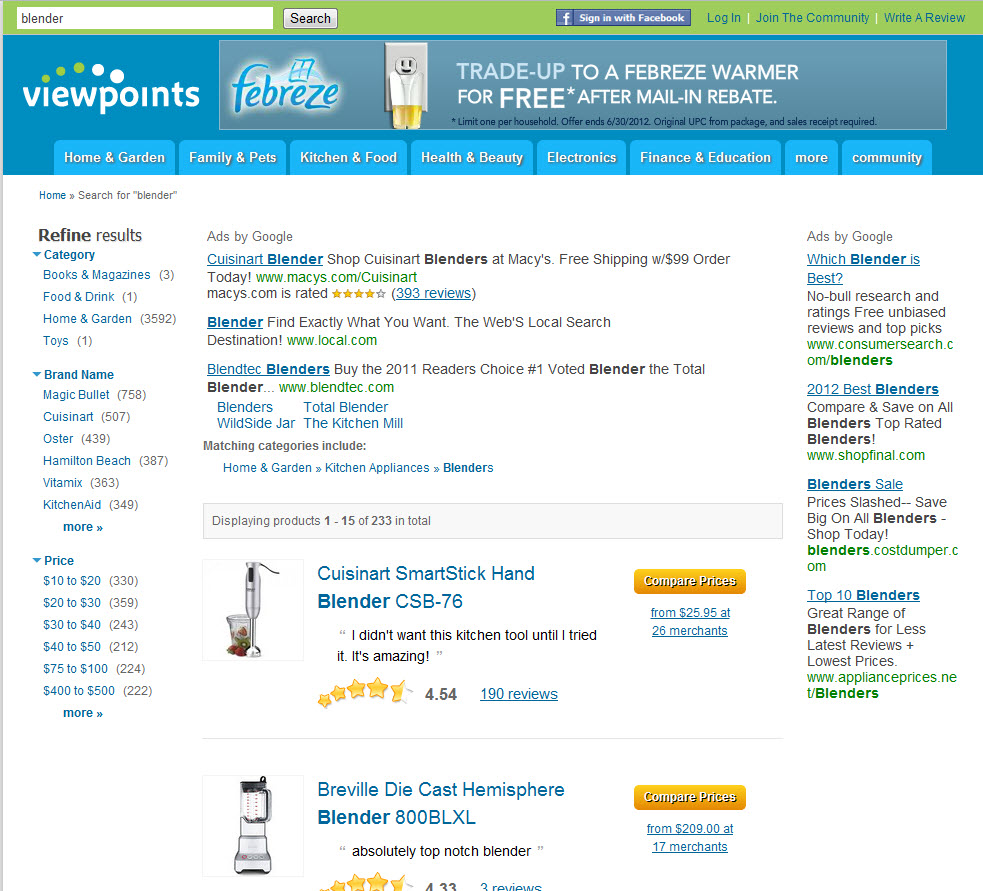
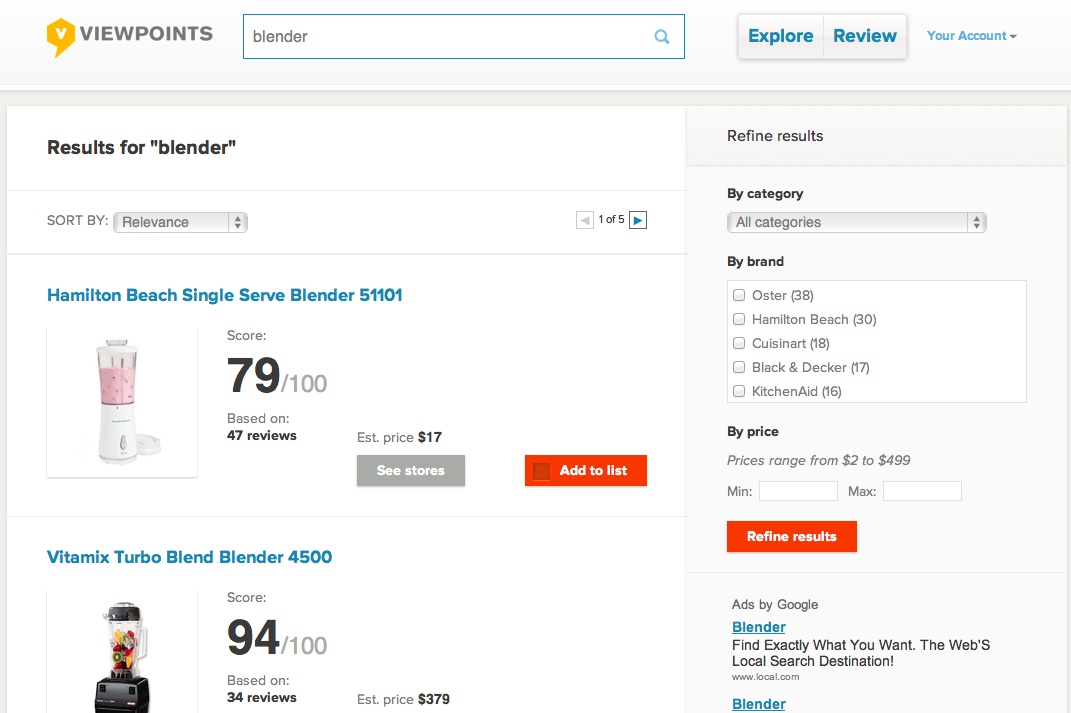
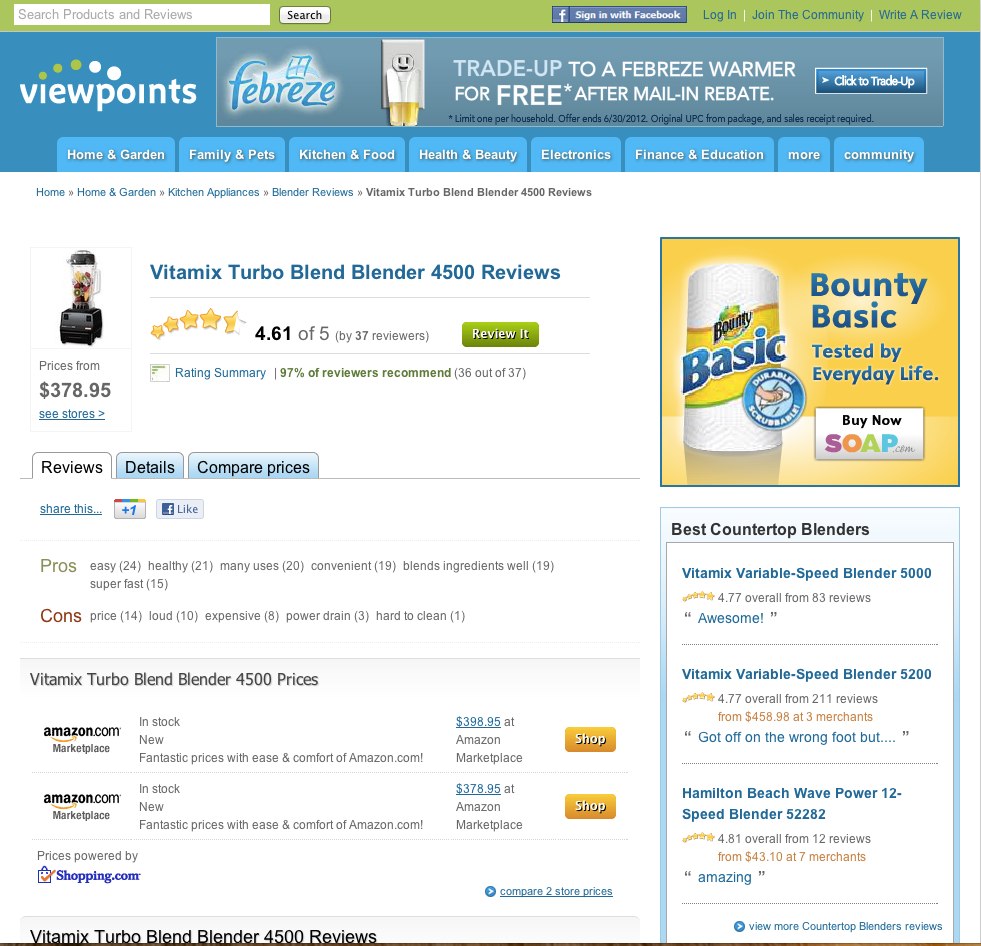
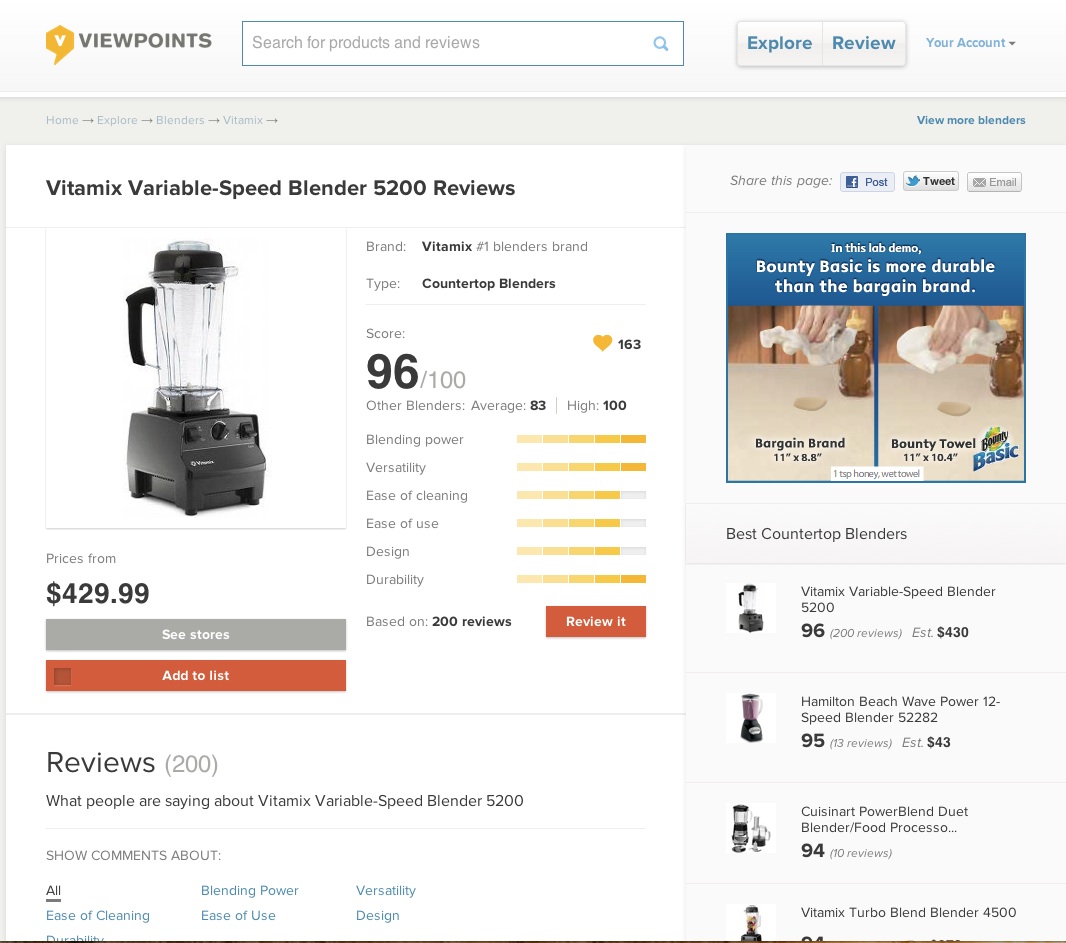
For Viewpoints, this meant cleaning up the content as outlined above as a first step, but it was also time for a redesign that was cleaner, simpler and better conveyed the credibility, quality and overall helpfulness of the site. In addition to eliminating 40% of the ads on the site, we also stripped out 15+ features that were clouding the core value proposition of consumer reviews and product rankings. For example, we made the decision to stop giving scores to products that did not have enough reviews. And we made it clear when members had connected their account to Facebook to demonstrate an extra layer of authenticity of the reviewer. You can see the following screen shots for some examples of the old design and the new.
OLD SEARCH RESULTS
NEW SEARCH RESULTS
OLD PRODUCT PAGE
NEW PRODUCT PAGE
Product Intelligence
So we have addressed content quality, site architecture and site credibility. But were we adding enough value to distinguish ourselves in a crowded market? Good question! While we firmly believe that getting the basics right (quality, credibility, ease of use etc) is the key to a great consumer reviews user experience, it became clear to us that there was another important way we could distinguish the Viewpoints user experience. We saw an opportunity to occupy the white space between expert reviews that make clear buy recommendations and the mass of consumer reviews which gave great consumer feedback but did not always help give a clear and concise buy recommendation.
We call this “Product Intelligence – for the consumer by the consumer“. We have spent a significant amount of time and resources developing scoring and ranking algorithms to smartly rank products against each other so that shoppers know what product to buy.
Diversification
As much as these changes were done to improve the user experience and in turn improve our rankings with Google, we also explicitly wanted to optimize mobile and social as two new channels that can be a new source of growing traffic to help us build our audience. The changes we made in these areas were very significant. The specific changes will be detailed in a later post.
Conclusion
So, that is how Google’s Panda update changed our business. It drove us to improve the quality of content, improve the credibility and trust of our experience and invest in Product Intelligence as a distinct point of difference in the market.
We don’t know how Google is going to respond to these changes but the important thing to note is that every change we made improved the experience for the user. So as disappointed as we were with the outcome of Panda, we will admit that it forced us to think harder about our business, about adding more value to the end user, and perhaps most importantly, take our game to another level. Game on.
09:04 0
samedi 3 mars 2012
Google’s Plan To Compete With Apple’s Multi-Platform Siri? Google “Assistant”

In fact a multi-platform Siri could be unveiled as early as next week, when Apple announces the iPad 3.
Hardcore right? Well our friends over in Mountain View, never ones to miss out on an opportunity to compete, have come up with their own answer to Siri, Google ‘Assistant’ (earlier reports had it pegged as ‘Majel,‘ I have no idea whether that name was scrapped but do know that ‘Assistant’ is not a part of GoogleX as Majel was).
Google has had the in-house voice technology for ages — it hired Mike Cohen, the guy who started Nuance. But ‘Assistant’ is set to go beyond Siri in many ways, most importantly in that the search company will retain complete control of all the layers involved.
The project, helmed by the Android team with the involvement of search engineer Amit Singhal, has three parts according to a source.
1) Get the world’s knowledge into a format a computer can understand.
2) Create a personalization layer — Experiments like Google +1 and Google+ are Google’s way of gathering data on precisely how people interact with content.
3) Build a mobile, voice-centered “Do engine” (‘Assistant’) that’s less about returning search results and more about accomplishing real-life goals.
Unlike Apple with Siri, Google is planning on extending this service to developers so they can build novel things. Imagine the possibilities for apps, websites, etc interested in hooking into ‘Assistant’?
From what I know, Google has now set its ambitions beyond social and is focused wholeheartedly on building this “Do engine,” or goal oriented search: 2011 was the year of social for Google. 2012 is the year of ‘Assistant.’
According to one source, Google higher-ups plan on unveiling the ‘Assistant’ product by the fourth quarter of 2012, though they themselves are uncertain. Because our details are sparse for now, the fact that we might be missing a huge piece of this puzzle is also a possibility.
12:49 0
jeudi 1 mars 2012
Chrome Beta for Android Hacked, Works On More Devices

XDA-Developer lenny_kano has put together an .apk that should let you run the browser on any device running on an ARM v7 or higher chip -- so long as you're also running Android 4.0 Ice Cream Sandwich.
If you are, and you'd like to try out Chrome Beta, head over to this thread on XDA-Developers, download the .apk, and side-load it onto your device. Enjoy!
07:08 0
Google Updates Trio of Apps: Wallet, Authenticator, Google+

Google Wallet finds itself getting the most significant updates of the trio, but we're still mainly in bugfix territory here. A couple changes have been introduced to how the app handles address input, letting you using a longer address or a PO Box when setting up a prepaid card. Reward cards linked to the app should now see improvements with keeping their data synced-up. Most of us struggle to find one smartphone on which we can run Wallet, but for those of you with multiple NFC-capable phones, this release will better handle sharing your account on more than one handset.
Google Authenticator, letting your use your phone to securely log in to your Google account on public terminals, gets some unspecified bug fixes, but seeing as the whole point of this app is security, we'd treat this release with a little more seriousness than your standard bugfix update. To that end, Google+ also gets some minor, unspecified bug fixes, along with improvements to app stability.
All three Google apps are currently available in the Android Market.
06:14 0
vendredi 24 février 2012
Google Updates Chrome for Android, Brings Speed Improvements

The newly-released Chrome for Android is already a fast, capable browser, even if it is technically still a beta release. After launching earlier this month, the browser now finds itself on the receiving end of a new update, but Google hasn't published any changelog to accompany it. Just what's new in the latest version of Chrome?
Probably the most noticeable change to occur in this update has to do with browser speed and responsiveness. The web-browsing experience should altogether feel a bit smoother, and benchmarks confirm the improvement.
Chrome should also start demonstrating smarter behavior when parsing links. Instead of trying to do everything in-browser, the browser is now better about giving you the opportunity to open links through associated apps. It's supposedly not quite all the way there yet, but it's an improvement over the initial release.
Not all the news surrounding this update has been positive. A number of users are turning to Android Market reviews to voice their frustration with the updated Chrome now trying to tell them that they're not running a supported version of Android, despite being on Ice Cream Sandwich. The problem may be related to custom ROMs like CyanogenMod 9, so if you're running such software, you may wish to hold off on updating Chrome until Google gets this glitch fixed.
13:29 0
Google to Enter Tablet Market With 7-Incher To Challenge Amazon?

Now, analysts have been proven wrong before but, given the fact that Mountain View already has a Nexus smartphone line-up, it would be normal to follow-up with "pure Android" tablets. Would you pick one up?
13:19 0
jeudi 23 février 2012
Google to Launch TV Service

The company filed an application last week to provide video service to residents of Kansas City, Mo., according to The Wall Street Journal. If approved, the service could launch as soon as a month from now, according to the article, which cites a “media executive currently involved in negotiations to license channels to the service.” Offerings in the video package would include live TV as well as on-demand and online access to TV channels, according to the report, which was based on an earlier article by The New York Post.
The source told the WSJ that Google plans to look beyond the Kansas City market and into other areas where Verizon’s Fiber Optic Services (FIOS). Controlling the pipes to TV subscribers would offer Google a new revenue stream.
Reps from Google could not be reached for comment.
The Kansas City application coincides with another request to put a satellite antenna farm near the company’s data center in Council Bluffs, Iowa. That addition could allow Google to receive movies and TV shows that could be bundled with a new Internet service in Kansas City that promises to be up to 100 times faster than the average Internet connection.
Google chose Kansas City for its ultra-fast service last March. Kansas City, Mo., and Kansas City, Kan., beat out about 1,000 other municipalities for that honor. That fiber-optic-based Internet service is expected to go live there this summer.
This isn’t the first time that Google’s ambitious plans for TV service have been exposed. The Wall Street Journal also reported in November that Google was in talks with Disney, Time Warner and Discovery Communications about providing content for its fiber-optic based video service in those cities.
07:07 0
mercredi 22 février 2012
Google Heads-Up Display Glasses Are Coming by the End of 2012 [REPORT]
 Google plans to launch glasses with a heads-up display by the end of 2012, the New York Times reports citing sources familiar with the matter.
The glasses, who were previously rumored to have a front-facing camera with flash and a voice input interface, will be Android based, sources say.
They will include a display, mere inches from the wearer’s eye, streaming real-time info about your surroundings, similar to the various augmented reality applications we’ve seen on smartphones.
The data will be fetched through a 3G/4G data connection, and the glasses will retrieve information about their surroundings through GPS and several sensors.
The glasses will cost “around the price of current smartphones,” sources say. While definitely not very precise – current smartphones cost anywhere from $150 to $600 – this price range shows that Google intends the glasses as a product for the mass market.
Will these glasses be something you need as opposed to want? We doubt it – we haven’t seen a must-have augmented reality application yet, although we have seen some very cool ones in the past.
AR heads-up display glasses, however, are the stuff sci-fi dreams are made of, and it’s a product we’d definitely like to see in the real world – even if they make us look like total geeks.
Image courtesy of Flickr, Jason McDermott.
[via New York Times]
08:21 0
Microsoft’s Clash With Google Over Privacy Settings May Be Part of a Larger Problem

It all started with Apple’s Safari Web browser. According to the Wall Street Journal, Google and other advertising companies have been using a special code to trick Safari into bypassing users’ privacy settings to monitor their activities online. Stanford grad student Jonathan Mayer first spotted the code. A follow-up investigation by WSJ advisor Ashkan Soltani revealed that the Google tracking code had been installed on a test computer through ads on 22 of the top 100 websites and that the code was also installed on an iPhone browser through ads on 23 sites. (Once the Journal contacted the company about the matter, Google disabled the code.)
When Microsoft heard that Google had circumvented user privacy settings on Safari, they wondered if Google was also bypassing users’ privacy preferences on Internet Explorer. Microsoft’s Internet Explorer corporate vice president Dean Hachamovitch wrote in a blog post, “We’ve discovered the answer is yes: Google is employing similar methods to get around the default privacy protections in IE and track IE users with cookies.”
The real issue, according to a blog post by TAP, is that the default setting Microsoft created to block third-party cookies has a bug. As a result, many companies – including Facebook – have been able to get around the requirement for third parties to summarize their privacy policies and offer users a way to opt out of sharing their personal data. The protocol for writing compact policies (CP), as defined by the Platform for Privacy Preferences Project (P3P), has not been widely implemented since it was first created in 2002 by the World Wide Web Consortium.
A Facebook representative told ZDNet, “While we would like to be able to express our cookie policy in a format that a browser could read, P3P was developed 5 years ago and is not effective in describing the practices of a modern social networking service and platform. Instead, we have posted a public notice describing our practices that is consistent with Section 3.2 of P3P. We have reached out directly to Microsoft in hopes of developing additional solutions and we would welcome the opportunity to work with W3 to update P3P to account for the advances in social networking and the web since 2007.”
Google’s response to Microsoft’s complaints said more or less the same thing. “Today the Microsoft policy is widely non-operational,” Google wrote. “A 2010 research report indicated that over 11,000 websites were not issuing valid P3P policies as requested by Microsoft.”
The complexity of the issue begs the question, is there an easier way to handle this? According to Jonathan Mayer, there is. He and fellow Stanford researcher Arvid Narayanan are currently working on Do Not Track, a policy proposal that would allow users to opt out of being tracked across all third-party sites, much like the Do Not Call Registry.
If it goes through, would you sign up?
Image by Gunnar Pippel via Shutterstock
07:30 0
Inscription à :
Articles (Atom)


