
Affichage des articles dont le libellé est nokia. Afficher tous les articles
Affichage des articles dont le libellé est nokia. Afficher tous les articles
vendredi 11 mai 2012
Why Microsoft Is Being Left in the Dust

There are now a number of companies — Apple, Google, Amazon, and others — that have Microsoft in their rear-view mirrors, disappearing quickly on the horizon in a cloud of dust.
That kick of dust in the company’s face is being emitted by Apple’s iPhone and iPad, Amazon’s Kindle, and Google’s search and cloud domination. Microsoft’s own wild lunges into various technology segments are also contributing considerably to it being left behind. Take the company’s recent partnership with Barnes & Noble, where it took 18% of the Nook e-reader for $605 million in cash and future guarantees. This was a move to compete with Amazon, but can it really compete?
If you want to know why Microsoft’s share price has been flat for 11 years while Apple, Amazon, and Google shares have soared, this is why. Microsoft is not innovating aggressively. It is not leading categories or blazing trails. No, it’s acquiring aggressively as a shortcut to innovation. That isn’t working. Its own history suggests as much.
Microsoft Has Not Capitalized on its Partnerships and Acquisitions
Last year, Microsoft announced a broad strategic partnership with Nokia, presumably to use Windows operating systems and software on Nokia’s smartphones. This was 15 months ago. But last week, a report found that Apple and Samsung generated 99 percent of the profits in the mobile phone category. Nokia, which once enjoyed more than half of all mobile phone profits, made zero.
In 2009, Microsoft acquired a 10-year license to use Yahoo’s core search technology, which later became the Bing search engine. Today, Google’s search market share is a dominant 66%, with Microsoft’s Bing a very distant second at 15%. After spending billions building and marketing Bing, Microsoft is barely visible in Google’s rear-view mirror.
Finally, what of Microsoft’s Skype acquisition a year ago? It’s too early to tell, but here’s a fact worth noting: The Wall Street Journal reports that 85% of Microsoft’s revenue comes from Windows and Office software. The rest of it? Barely a blip.
And so, Microsoft is proving, like many have before it, that acquiring companies outside your core competencies are recipes for failure. Remember when Cisco purchased the Flip video camera, at the time one of the most popular consumer electronics products on the planet? How did that work out? In 2010, HP bought Palm for $1.2 billion, but we haven’t seen any industry-altering smartphones from HP.
Conversely, consider Apple’s acquisition of Siri: a technology that immediately and profoundly complimented and enhanced its iPhone. It fit obviously and very successfully.
Microsoft Does Not Need to Compete with Amazon
Another major problem with Microsoft’s partnership involving the Nook is that there is simply no need for it to compete with Amazon. This is like Best Buy focusing all of its efforts on its ecommerce site while neglecting its one major competitive advantage: its brick-and-mortar stores. This is also like Research in Motion spending a year building its atrociously received tablet, the PlayBook, while neglecting its core competency of Blackberry smartphones.
Microsoft dominates the competition in computer operating systems and software. Computers are dying, right? And yet, in May 2012, there is no Microsoft Office for tablets and smartphones. Millions of iPads and Android tablets are being adopted in corporate environments, and most of those customers would be happy to spend $70 on Microsoft Office for each device. Except, it does not exist.
I can only guess why: because with its many categories, acquisitions and partnerships, Microsoft is physically incapable of putting its full focus behind converting its desktop products to mobile devices.
Microsoft is Going Wide, Not Deep
Which brings me to the third and final big problem with Microsoft’s Nook play. It is keeping with the strategy of going as wide as possible. Microsoft is not, and cannot be, all things to all people. In fact, no company can.
Here’s the truth: The wider you go, the more priorities you focus on, the less chance you have to be successful. But when you go deep, you can dominate. (See Apple, and Amazon.) When you go deep, you can continue perfecting. You become the world’s expert on a certain specialty. Apple is seen as the world’s expert on smartphones and tablets. Amazon is the accepted leader in online shopping and electronic reading. It’s because these two companies relentlessly focus on their strengths, saying no to nearly everything else. No. That’s a word Microsoft should consider trying out before it gets left in the dust permanently.
12:05 1
mardi 10 avril 2012
Microsoft and Nokia Begin Massive Marketing Push Behind Lumia 900
On the heels of putting on a free Nicki Minaj concert in Times Square on Friday, the big marketing push behind the Lumia 900 smartphone went into high gear this week in New York City.
To draw attention to the Nokia Lumia 900 — the first U.S. Windows Phone to boast a high-speed LTE network connection — Microsoft set up an event in Madison Square Park on Monday to give people a chance to check out the new device. The Lumia 900 (which costs $100 with a two-year contract) debuted on Easter Sunday and is yesterday was listed as the number one smartphone on Amazon.
Nokia and Windows aim to differentiate the device in the marketplace by highlighting its LTE network connection, which is far faster than the iPhone’s speed capabilities. New Yorkers who participated in a two-minute demo of the new Lumia 900 device or HTC Titan II device, which also runs on the LTE network, were given a ticket to win “time-saver” prizes.
Those randomly awarded special tickets could tap on an enlarged Lumia 900 touchscreen and win prizes that save them time, from a gift certificate for a local dog walker or having a member of the event staff wait in line for them at popular burger joint Shake Shack, located behind the event space.
“Since the LTE network is so fast, the event focuses on how the Lumia 900 saves you time with its fast speeds,” an event coordinator told Mashable. “It’s been a big success so far.”
An event employee with a microphone also told people in the park that the device runs “much faster than the iPhone” and that it’s the best phone on the market. Although the device launched on Sunday, it was reportedly difficult to purchase the Lumia 900 as nearly all 39 AT&T stores located near Times Square were either closed for Easter Sunday, according to the New York Times.
To create buzz for the launch, Nokia hired Nicki Minaj to put on a free live show in the middle of Times Square on Friday. She performed several songs on a Nokia-branded stage, surrounded by billboards that also promoted the new device. In addition to shout outs about Nokia and the Lumia 900, Minaj also filmed a remix of her song hit “Starships” that has already been watched more than 300,000 times on YouTube. Minaj also promoted her new album “Pink Friday: Roman Reloaded.”
In addition, Nokia launched last week a nationwide marketing campaign called smartphonbetatest that lead up to the launch. The strategy implied that other smartphones were only in beta before the launch of the Lumia 900. However, the site appeared to suffer from poor planning — it counted down to zero several times before launch day, only to have more hours added to the clock each time.
To draw attention to the Nokia Lumia 900 — the first U.S. Windows Phone to boast a high-speed LTE network connection — Microsoft set up an event in Madison Square Park on Monday to give people a chance to check out the new device. The Lumia 900 (which costs $100 with a two-year contract) debuted on Easter Sunday and is yesterday was listed as the number one smartphone on Amazon.
Nokia and Windows aim to differentiate the device in the marketplace by highlighting its LTE network connection, which is far faster than the iPhone’s speed capabilities. New Yorkers who participated in a two-minute demo of the new Lumia 900 device or HTC Titan II device, which also runs on the LTE network, were given a ticket to win “time-saver” prizes.
Those randomly awarded special tickets could tap on an enlarged Lumia 900 touchscreen and win prizes that save them time, from a gift certificate for a local dog walker or having a member of the event staff wait in line for them at popular burger joint Shake Shack, located behind the event space.
“Since the LTE network is so fast, the event focuses on how the Lumia 900 saves you time with its fast speeds,” an event coordinator told Mashable. “It’s been a big success so far.”
An event employee with a microphone also told people in the park that the device runs “much faster than the iPhone” and that it’s the best phone on the market. Although the device launched on Sunday, it was reportedly difficult to purchase the Lumia 900 as nearly all 39 AT&T stores located near Times Square were either closed for Easter Sunday, according to the New York Times.
To create buzz for the launch, Nokia hired Nicki Minaj to put on a free live show in the middle of Times Square on Friday. She performed several songs on a Nokia-branded stage, surrounded by billboards that also promoted the new device. In addition to shout outs about Nokia and the Lumia 900, Minaj also filmed a remix of her song hit “Starships” that has already been watched more than 300,000 times on YouTube. Minaj also promoted her new album “Pink Friday: Roman Reloaded.”
In addition, Nokia launched last week a nationwide marketing campaign called smartphonbetatest that lead up to the launch. The strategy implied that other smartphones were only in beta before the launch of the Lumia 900. However, the site appeared to suffer from poor planning — it counted down to zero several times before launch day, only to have more hours added to the clock each time.
Hands on the Lumia 900
Microsoft set up an event in Madison Square Park on Monday to give people a chance to test the new Lumia 900 smartphone.


Lumia 900 Marketing Event in New York City
The phone --
manufactured by Nokia and powered by Windows software -- aims to
differentiate the itself by highlighting its ultra-fast LTE network
connection.


Window's HTC Titan II Smartphone
Testing the HTC Titan II device, which also runs on the LTE network.


15:48 0
lundi 2 avril 2012
Nokia Lumia 900 Tops Amazon's Best-Selling AT&T Phone Chart
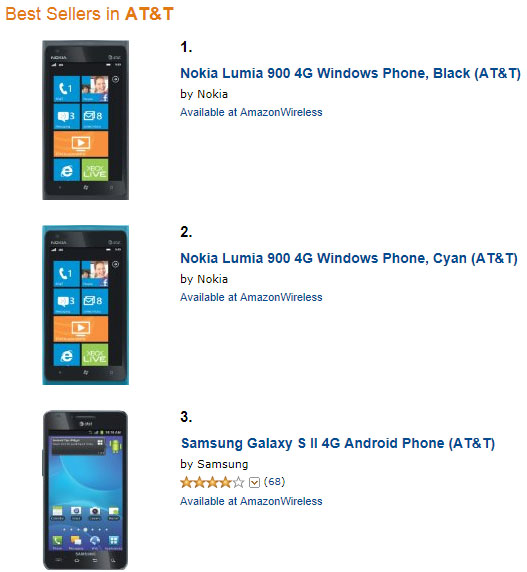
As you can see in the image above (and at the source link below), we not only have one, but two Nokia Lumia 900 phones on the top spots of Amazon's best-selling AT&T devices. Both the black and cyan variants rule the list and this is just three days after the official pre-orders received the green light. Furthermore, Amazon's list of best-selling cell phones with service plans features the two Lumia 900 phones at five and seven. This is great news for both Microsoft and Nokia fans in the U.S.
10:28 0
Nokia 'Smartphone Beta Test' Campaign Targets Competitor

At a first glance, there's no indication that we're looking at an official Nokia website. However, if you take a closer look at the top left, you can almost see the Nokia logo under that black chalk. That, and some references to Nokia's website found inside the web page's code by WPCentral.
On to the content: there are three videos, Exhibit A, B and C, where a certain phone that is losing signal is referenced, another one (or the same, really) which has its screen all washed out in the sun and a third one which seems to be too fragile. You'd be inclined to immediately think Apple but then again a question should immediately follow up: why is everyone picking on Apple? (yes, Samsung too). But then again, it might not be all anti-Apple.
Regardless, the campaign (if it turns out to be one, which wouldn't surprise us with lots of cash and brilliant minds at Nokia) is both funny and serious at the same time, but definitely a great one. Check it out at the source link below and let us know of your comments!
10:20 0
lundi 27 février 2012
Nokia 808 PureView Has a Monster 41-Megapixel Camera

You read that right, 41 megapixels – Nokia has made this happen by combining Carl Zeiss optics and Nokia-developed pixel over-sampling technology. High megapixel count does not equal quality photos, of course – we’re looking forward to seeing how PureView tech works in real life.
Of course, the PureView technology will be coming to upcoming Nokia phones as well, so get used to phones having crazy megapixel numbers in the near future.
The 808 PureView also features something called Rich Recording, which lets you record “crisp, clear audio (…) up to a thumping 140 decibels,” says Nokia.
The rest of the specs mostly spell mid-range: a single core 1.3 GHz CPU, a 4-inch, 360 x 640 pixel screen, 512 MB of RAM and 16 GB of storage.
The device will retail for 450 euros, hitting the market in May.
And, going back to the question we asked at the beginning – whether Symbian is dead, as many have predicted – Nokia declined to say. In any way, even if 808 PureView is the last Symbian we see, at least the PureView technology will live on in other handsets.
SONY DSC

SONY DSC

SONY DSC

SONY DSC

SONY DSC

SONY DSC

SONY DSC

SONY DSC

SONY DSC

SONY DSC

SONY DSC

SONY DSC

SONY DSC

SONY DSC

SONY DSC

SONY DSC

SONY DSC

SONY DSC

SONY DSC

SONY DSC

SONY DSC

SONY DSC

SONY DSC

src:http://mashable.com
08:42 1
lundi 20 février 2012
Nokia Siemens Network, Qualcomm Prepare MultiFlow HSPA+ To Keep Data Signals Strong

That said, the Nokia Siemens Network and Qualcomm are putting together a new network technology called HSPA+ MultiFlow. It’ll basically allow for one person to use the connection from two different base stations to heighten network efficiency.
So, in other words, if you were near the very edge of a network base station’s cell coverage, your phone would automatically connect to the next closest cell along with the one it’s on to make sure that what would be a rather choppy connection (connected to just one of the stations) is nice and smooth (thanks to a connection to both stations).
The duo is set to show off the technology at Mobile World Congress in about a week.
According to the official release, MultiFlow HSPA+ can up to double data speeds for users at the edge of cell coverage. What’s even better, it doesn’t take billions of dollars in installation to set up. Carriers can use a simple software upgrade to their existing HSPA+ network to enable MultiFlow.

11:00 0
mercredi 8 février 2012
Nokia Cuts 4000 European Jobs; Phone Assembly Moves To Asia

The news and layoffs were expected, as the company has slashed many more thousands of jobs over the last year, but this particular cut is symbolic: the intensely European company has been battered into submission, and will join the others in the now-standard configuration of “design here, build there.”
The job losses are 2300 in Hungary, 1000 in Finland, and 700 in Mexico. They don’t represent all of Nokia’s employees in those countries, just those involved with basic assembly. Nokia did not say where or to what contractor the jobs would be sent, but considering their need to cut costs, the majors in China, Taiwan, Thailand, and others in the area are the natural choice.
Naturally, the countries losing the jobs expressed disappointment, but Nokia’s got to do what Nokia’s got to do, and these job losses have been telegraphed for some time. It’s likely that they were announced today only after extensive negotiations with unions and local contractors.
Whether this approach will prove effective at lowering costs without damaging the company or brand is yet to be seen; it may be that saving money on manufacturing might not be enough to counter the enormous drop in sales Nokia has seen over the last two years.
14:59 0
Inscription à :
Articles (Atom)


