2222
Home » Posts filed under amazon
Affichage des articles dont le libellé est amazon. Afficher tous les articles
vendredi 11 mai 2012
Why Microsoft Is Being Left in the Dust
Alex Goldfayn’s new book is called Evangelist Marketing: What Apple Amazon and Netflix Understand About Their Customers (That Your Company Probably Doesn’t).
He is CEO of the Evangelist Marketing Institute, a marketing
consultancy with clients that include T-Mobile, TiVo, and Logitech.
Follow him @alexgoldfayn.
There are now a number of companies — Apple, Google, Amazon, and others — that have Microsoft in their rear-view mirrors, disappearing quickly on the horizon in a cloud of dust.
That kick of dust in the company’s face is being emitted by Apple’s iPhone and iPad, Amazon’s Kindle, and Google’s search and cloud domination. Microsoft’s own wild lunges into various technology segments are also contributing considerably to it being left behind. Take the company’s recent partnership with Barnes & Noble, where it took 18% of the Nook e-reader for $605 million in cash and future guarantees. This was a move to compete with Amazon, but can it really compete?
If you want to know why Microsoft’s share price has been flat for 11 years while Apple, Amazon, and Google shares have soared, this is why. Microsoft is not innovating aggressively. It is not leading categories or blazing trails. No, it’s acquiring aggressively as a shortcut to innovation. That isn’t working. Its own history suggests as much.
Last year, Microsoft announced a broad strategic partnership with Nokia, presumably to use Windows operating systems and software on Nokia’s smartphones. This was 15 months ago. But last week, a report found that Apple and Samsung generated 99 percent of the profits in the mobile phone category. Nokia, which once enjoyed more than half of all mobile phone profits, made zero.
In 2009, Microsoft acquired a 10-year license to use Yahoo’s core search technology, which later became the Bing search engine. Today, Google’s search market share is a dominant 66%, with Microsoft’s Bing a very distant second at 15%. After spending billions building and marketing Bing, Microsoft is barely visible in Google’s rear-view mirror.
Finally, what of Microsoft’s Skype acquisition a year ago? It’s too early to tell, but here’s a fact worth noting: The Wall Street Journal reports that 85% of Microsoft’s revenue comes from Windows and Office software. The rest of it? Barely a blip.
And so, Microsoft is proving, like many have before it, that acquiring companies outside your core competencies are recipes for failure. Remember when Cisco purchased the Flip video camera, at the time one of the most popular consumer electronics products on the planet? How did that work out? In 2010, HP bought Palm for $1.2 billion, but we haven’t seen any industry-altering smartphones from HP.
Conversely, consider Apple’s acquisition of Siri: a technology that immediately and profoundly complimented and enhanced its iPhone. It fit obviously and very successfully.
Another major problem with Microsoft’s partnership involving the Nook is that there is simply no need for it to compete with Amazon. This is like Best Buy focusing all of its efforts on its ecommerce site while neglecting its one major competitive advantage: its brick-and-mortar stores. This is also like Research in Motion spending a year building its atrociously received tablet, the PlayBook, while neglecting its core competency of Blackberry smartphones.
Microsoft dominates the competition in computer operating systems and software. Computers are dying, right? And yet, in May 2012, there is no Microsoft Office for tablets and smartphones. Millions of iPads and Android tablets are being adopted in corporate environments, and most of those customers would be happy to spend $70 on Microsoft Office for each device. Except, it does not exist.
I can only guess why: because with its many categories, acquisitions and partnerships, Microsoft is physically incapable of putting its full focus behind converting its desktop products to mobile devices.
Which brings me to the third and final big problem with Microsoft’s Nook play. It is keeping with the strategy of going as wide as possible. Microsoft is not, and cannot be, all things to all people. In fact, no company can.
Here’s the truth: The wider you go, the more priorities you focus on, the less chance you have to be successful. But when you go deep, you can dominate. (See Apple, and Amazon.) When you go deep, you can continue perfecting. You become the world’s expert on a certain specialty. Apple is seen as the world’s expert on smartphones and tablets. Amazon is the accepted leader in online shopping and electronic reading. It’s because these two companies relentlessly focus on their strengths, saying no to nearly everything else. No. That’s a word Microsoft should consider trying out before it gets left in the dust permanently.
There are now a number of companies — Apple, Google, Amazon, and others — that have Microsoft in their rear-view mirrors, disappearing quickly on the horizon in a cloud of dust.
That kick of dust in the company’s face is being emitted by Apple’s iPhone and iPad, Amazon’s Kindle, and Google’s search and cloud domination. Microsoft’s own wild lunges into various technology segments are also contributing considerably to it being left behind. Take the company’s recent partnership with Barnes & Noble, where it took 18% of the Nook e-reader for $605 million in cash and future guarantees. This was a move to compete with Amazon, but can it really compete?
If you want to know why Microsoft’s share price has been flat for 11 years while Apple, Amazon, and Google shares have soared, this is why. Microsoft is not innovating aggressively. It is not leading categories or blazing trails. No, it’s acquiring aggressively as a shortcut to innovation. That isn’t working. Its own history suggests as much.
Microsoft Has Not Capitalized on its Partnerships and Acquisitions
Last year, Microsoft announced a broad strategic partnership with Nokia, presumably to use Windows operating systems and software on Nokia’s smartphones. This was 15 months ago. But last week, a report found that Apple and Samsung generated 99 percent of the profits in the mobile phone category. Nokia, which once enjoyed more than half of all mobile phone profits, made zero.
In 2009, Microsoft acquired a 10-year license to use Yahoo’s core search technology, which later became the Bing search engine. Today, Google’s search market share is a dominant 66%, with Microsoft’s Bing a very distant second at 15%. After spending billions building and marketing Bing, Microsoft is barely visible in Google’s rear-view mirror.
Finally, what of Microsoft’s Skype acquisition a year ago? It’s too early to tell, but here’s a fact worth noting: The Wall Street Journal reports that 85% of Microsoft’s revenue comes from Windows and Office software. The rest of it? Barely a blip.
And so, Microsoft is proving, like many have before it, that acquiring companies outside your core competencies are recipes for failure. Remember when Cisco purchased the Flip video camera, at the time one of the most popular consumer electronics products on the planet? How did that work out? In 2010, HP bought Palm for $1.2 billion, but we haven’t seen any industry-altering smartphones from HP.
Conversely, consider Apple’s acquisition of Siri: a technology that immediately and profoundly complimented and enhanced its iPhone. It fit obviously and very successfully.
Microsoft Does Not Need to Compete with Amazon
Another major problem with Microsoft’s partnership involving the Nook is that there is simply no need for it to compete with Amazon. This is like Best Buy focusing all of its efforts on its ecommerce site while neglecting its one major competitive advantage: its brick-and-mortar stores. This is also like Research in Motion spending a year building its atrociously received tablet, the PlayBook, while neglecting its core competency of Blackberry smartphones.
Microsoft dominates the competition in computer operating systems and software. Computers are dying, right? And yet, in May 2012, there is no Microsoft Office for tablets and smartphones. Millions of iPads and Android tablets are being adopted in corporate environments, and most of those customers would be happy to spend $70 on Microsoft Office for each device. Except, it does not exist.
I can only guess why: because with its many categories, acquisitions and partnerships, Microsoft is physically incapable of putting its full focus behind converting its desktop products to mobile devices.
Microsoft is Going Wide, Not Deep
Which brings me to the third and final big problem with Microsoft’s Nook play. It is keeping with the strategy of going as wide as possible. Microsoft is not, and cannot be, all things to all people. In fact, no company can.
Here’s the truth: The wider you go, the more priorities you focus on, the less chance you have to be successful. But when you go deep, you can dominate. (See Apple, and Amazon.) When you go deep, you can continue perfecting. You become the world’s expert on a certain specialty. Apple is seen as the world’s expert on smartphones and tablets. Amazon is the accepted leader in online shopping and electronic reading. It’s because these two companies relentlessly focus on their strengths, saying no to nearly everything else. No. That’s a word Microsoft should consider trying out before it gets left in the dust permanently.
12:05 by Robert dawne · 1
mardi 10 avril 2012
Following Apple’s and Google’s Lead, Amazon Enables In-App Purchases
After a relatively short test period, Amazon announced Tuesday that developers can now set up in-app purchases within apps offered in the Amazon Appstore.
The move gives the developers an opportunity to earn more money through in-app upgrades, expansions, subscriptions (essential to publishers) and virtual good purchases. It also makes Amazon’s Appstore more competitive with Apple’s and Google’s app stores, both of which have enabled in-app purchasing since spring 2009 and spring 2011, respectively.
Like Apple and Google, Amazon will keep 30% of all revenue generated through in-app purchases.
Developers and publishers including Disney, Gameloft, G5 Entertainment, Conde Nast and Dow Jones were given early access to Amazon’s in-app purchasing API, and will begin offering in-app purchases Tuesday. In a statement, Larissa McCleary, director of marketing at G5 Entertainment, noted that enabling in-app purchases upped conversion rates and revenue in all of the games G5 offers in the Amazon Appstore.
In-app purchases are becoming an increasingly important source of revenue for developers. According to a study conducted by IHS, in-app purchases generated $970 million in revenue in 2011, accounting for 39% of all smartphone app revenue that year. Those figures are only expected to grow, bringing in $5.6 billion — 64% of all smartphone app revenue — in 2015.
Amazon released the above video to introduce developers to its new, in-app purchasing service.
The move gives the developers an opportunity to earn more money through in-app upgrades, expansions, subscriptions (essential to publishers) and virtual good purchases. It also makes Amazon’s Appstore more competitive with Apple’s and Google’s app stores, both of which have enabled in-app purchasing since spring 2009 and spring 2011, respectively.
Like Apple and Google, Amazon will keep 30% of all revenue generated through in-app purchases.
Developers and publishers including Disney, Gameloft, G5 Entertainment, Conde Nast and Dow Jones were given early access to Amazon’s in-app purchasing API, and will begin offering in-app purchases Tuesday. In a statement, Larissa McCleary, director of marketing at G5 Entertainment, noted that enabling in-app purchases upped conversion rates and revenue in all of the games G5 offers in the Amazon Appstore.
In-app purchases are becoming an increasingly important source of revenue for developers. According to a study conducted by IHS, in-app purchases generated $970 million in revenue in 2011, accounting for 39% of all smartphone app revenue that year. Those figures are only expected to grow, bringing in $5.6 billion — 64% of all smartphone app revenue — in 2015.
Amazon released the above video to introduce developers to its new, in-app purchasing service.
16:27 by Robert dawne · 0
lundi 2 avril 2012
Nokia Lumia 900 Tops Amazon's Best-Selling AT&T Phone Chart
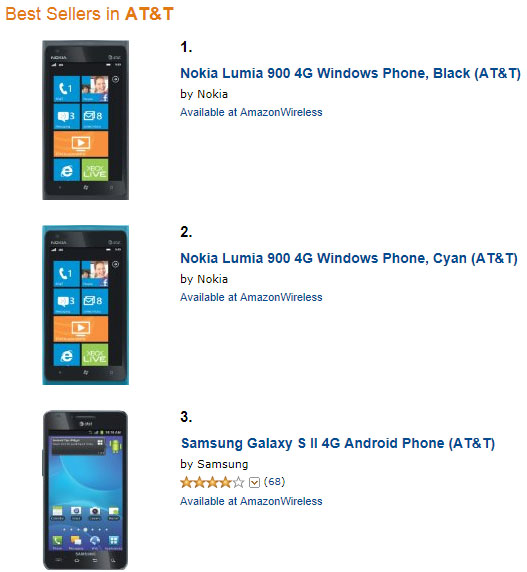
Aside from the fact that the Nokia Lumia 900 is already on back-order with Amazon Wireless -- the phone officially went on pre-order on March 30 with an in-store availability date announced for April 8 -- it appears that it is doing quite well.
As you can see in the image above (and at the source link below), we not only have one, but two Nokia Lumia 900 phones on the top spots of Amazon's best-selling AT&T devices. Both the black and cyan variants rule the list and this is just three days after the official pre-orders received the green light. Furthermore, Amazon's list of best-selling cell phones with service plans features the two Lumia 900 phones at five and seven. This is great news for both Microsoft and Nokia fans in the U.S.
10:28 by Robert dawne · 0
vendredi 24 février 2012
Google to Enter Tablet Market With 7-Incher To Challenge Amazon?
A recent report suggests the search giant may release a 7-inch tablet
later on this year, a device that would compete (size and price-wise) in
the same class as Amazon's Kindle Fire. Analysts at Display Search
claim that Google's potential tablet will feature a 7-inch display, 1280
x 800 resolution and should enter production in April, with 1.5 million
planned for initial production. It is also expected that the tablet
will run on Android 4.0 Ice Cream Sandwich and will be priced around
$199.
Now, analysts have been proven wrong before but, given the fact that Mountain View already has a Nexus smartphone line-up, it would be normal to follow-up with "pure Android" tablets. Would you pick one up?
13:19 by Robert dawne · 0
lundi 20 février 2012
Barnes & Noble To Take On Amazon (Again) With A New 8GB Nook Tablet
Barnes & Noble seemed pleasantly surprised when they announced their Nook Tablet “exceeded expectations” over the holidays, but their 70% year-over-year jump in device sales paled in comparison to rival Amazon’s 177%.
That their flagship Nook Tablet cost a full $50 more than the Kindle Fire certainly didn’t help, but that should change soon — according to a document obtained by The Verge, Barnes & Noble will release a new 8GB version of the Nook Tablet on February 22.
While the original Nook Tablet sported 16GB of onboard memory, the new version will feature the same amount as the bestselling Kindle Fire. A decrease in memory capacity also signals a corresponding dip for the price tag, which means that BN is looking to take Amazon on at their own game. It’s a smart, if possibly-overdue move for BN — Amazon has already been playing up their price advantage with a national marketing campaign, and while it targets the iPad specifically, the message still applies to BN’s slightly pricier tablet.
Still, I wouldn’t expect the price break to be a panacea for the book retailer. If the new model Nook retails at or around the $199 price point, purchasing decisions may well come down to the strength of the ecosystem behind the device, an arena where Amazon has the edge. The Kindle Fire isn’t so much a tablet is it as a portal to the rest of Amazon’s media ecosystem, and the included Amazon Prime trial grants access to faster shipping in addition to streaming video content.
That’s not to say that the Nook Tablet is a slouch — John considers it a better device for handling content and media on the device itself — but BN will have their work cut out for them regardless.
While Amazon and BN continue to slug it out for the low-cost tablet crown, they should also be mindful of their flanks. With devices like the 7-inch Tegra-powered Asus MeMo tablet barreling down the pipeline, the bar for device performance may shift in a way that Amazon and BN aren’t prepared to compete with yet.
That their flagship Nook Tablet cost a full $50 more than the Kindle Fire certainly didn’t help, but that should change soon — according to a document obtained by The Verge, Barnes & Noble will release a new 8GB version of the Nook Tablet on February 22.
While the original Nook Tablet sported 16GB of onboard memory, the new version will feature the same amount as the bestselling Kindle Fire. A decrease in memory capacity also signals a corresponding dip for the price tag, which means that BN is looking to take Amazon on at their own game. It’s a smart, if possibly-overdue move for BN — Amazon has already been playing up their price advantage with a national marketing campaign, and while it targets the iPad specifically, the message still applies to BN’s slightly pricier tablet.
Still, I wouldn’t expect the price break to be a panacea for the book retailer. If the new model Nook retails at or around the $199 price point, purchasing decisions may well come down to the strength of the ecosystem behind the device, an arena where Amazon has the edge. The Kindle Fire isn’t so much a tablet is it as a portal to the rest of Amazon’s media ecosystem, and the included Amazon Prime trial grants access to faster shipping in addition to streaming video content.
That’s not to say that the Nook Tablet is a slouch — John considers it a better device for handling content and media on the device itself — but BN will have their work cut out for them regardless.
While Amazon and BN continue to slug it out for the low-cost tablet crown, they should also be mindful of their flanks. With devices like the 7-inch Tegra-powered Asus MeMo tablet barreling down the pipeline, the bar for device performance may shift in a way that Amazon and BN aren’t prepared to compete with yet.
11:45 by Robert dawne · 0
vendredi 10 février 2012
Is Amazon Web Services’ ‘SWF’ A New Workflow Manager?
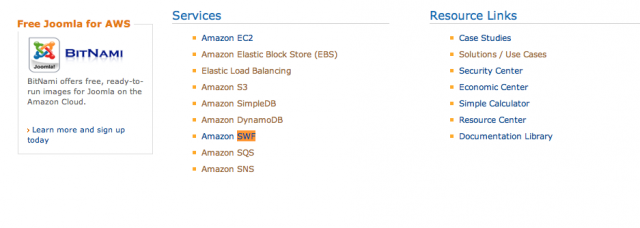
It looks like Amazon Web Services may be launching a new workflow manager called SWF. First spotted by TechCrunch reader Michael Hood, SWF is listed as a service under AWS’ Free Usage Tier. Unfortunately, clicking on SWF takes you to a ’404′ page.
Upon further digging, it looks like SWF stands for ‘Amazon Simple Workflow Service.’ It basically starts, runs, and retains workflow executions, as well as schedules tasks, adds markers, receives signals, and starts timers for those workflow executions. According to the information listed, with the free usage tier, “1,000 Amazon SWF executions can be initiated for free. A total of 10,000 activity tasks, signals, timers and markers and 30,000 workflow-days can also be used for free.”
Amazon’s free usage tier allows users to run a free Amazon EC2 Micro Instance for a year, and use Amazon S3, Amazon Elastic Block Store, Amazon Elastic Load Balancing, and AWS data transfer for free as well. AWS’s free usage tier can be used to run an application in the cloud, including launching new applications, testing existing applications in the cloud, or more. SWF would be included for free in this package.
Obviously, with so little information, it’s hard to determine the exact details of what SWF does or who it will compete with at this point, but it appears to be new. We’ve reached out to Amazon for comment and will update when we hear back.
Update: Amazon has taken all mentions of SWF off of the AWS Free Usage Tier Site; and has yet to comment.
We’ve embedded screenshots below:
Upon further digging, it looks like SWF stands for ‘Amazon Simple Workflow Service.’ It basically starts, runs, and retains workflow executions, as well as schedules tasks, adds markers, receives signals, and starts timers for those workflow executions. According to the information listed, with the free usage tier, “1,000 Amazon SWF executions can be initiated for free. A total of 10,000 activity tasks, signals, timers and markers and 30,000 workflow-days can also be used for free.”
Amazon’s free usage tier allows users to run a free Amazon EC2 Micro Instance for a year, and use Amazon S3, Amazon Elastic Block Store, Amazon Elastic Load Balancing, and AWS data transfer for free as well. AWS’s free usage tier can be used to run an application in the cloud, including launching new applications, testing existing applications in the cloud, or more. SWF would be included for free in this package.
Obviously, with so little information, it’s hard to determine the exact details of what SWF does or who it will compete with at this point, but it appears to be new. We’ve reached out to Amazon for comment and will update when we hear back.
Update: Amazon has taken all mentions of SWF off of the AWS Free Usage Tier Site; and has yet to comment.
We’ve embedded screenshots below:
20:00 by Robert dawne · 0
Inscription à :
Articles (Atom)


