
lundi 2 avril 2012
Would You Fire Someone for Trying to Make a Co-Worker Laugh?

But like many workplace-related giggles gone awry in the 21st century, this one begins in social media, or more specifically, Facebook.
In April 2011 Kimberly Hester, a teacher's aide at Frank Squires Elementary in the village of Cassopolis, Michigan, posted to Facebook a photo of a co-worker's pants around her ankles and a pair of shoes. The caption: “Thinking of you." (See the photo here.)
“It was very mild, no pornography,” Hester told Michigan's WSBT TV station. She added: “It wasn't at work, it was off work time."
A parent at Lewis Cass Intermediate who was friends with Hester on the social network promptly alerted the school to the photo. (Hester's aide job was at the elementary school, but she technically was employed by Lewis-Cass Intermediate.)
Lewis Cass Intermediate superintendent Robert Colby called Hester into his office a few days later and, according to her, asked her three times for access to her Facebook page, which was private.
"I repeatedly said I was not OK with that,” Hester told WSBT.
Within days, Hester received a letter from the Lewis Cass ISD Special Education Director, which she provided the TV station. It read, in part: “…in the absence of you voluntarily granting Lewis Cass ISD administration access to you[r] Facebook page, we will assume the worst and act accordingly."
She was put on administrative leave and eventually suspended.
“I have the right to privacy,” she told WSBT.
Hester has taken legal action.
“I stand by it,” she said. “I did nothing wrong. And I would not, still to this day, let them in my Facebook. And I don’t think it’s OK for an employer to ask you.”
But University of Notre Dame labor law professor Barbara Frick told the TV station that the school didn’t break any laws by asking for Hester’s Facebook information.
Right now there are no state or federal laws protecting social media privacy in the workplace, Frick said. Michigan currently is one of several states pushing for legislation that would make an employer's asking for a Facebook password illegal, though–and the social network itself has said it will seek legal action against offending employers.
Both sides are scheduled to go to arbitration in May.
Last week, Republicans in the U.S. House of Representatives defeated an amendment titled "Mind Your Own Business on Passwords", that would have banned employers demanding access to Facebook accounts. (Democrats had added the provision to a larger Federal Communications Commission reform package.) It can still return as separate legislation.
Also last week, a pair of senators (Democrats Charles Schumer of New York and Richard Blumenthal of Connecticut) called for an investigation to determine whether employers asking for Facebook passwords are breaking the law. They sent letters to the U.S. Department of Justice and the U.S. Equal Employment Opportunity Commission, questioning whether the practice is in violation of laws prohibiting intentional unauthorized access to electronic information.
19:00 0
3 Questions to Keep Your Employees Engaged and Passionate

Eric Jackson, Forbes blogger, recently did a post on the "Top Ten Reasons Why Large Companies Fail to Keep Their Best Talent" that received almost two million views. While I agree with all ten of his reasons, the one that I believe impacts small business the most is the second item on his list: "Failing to find a project for the talent that ignites there passion."
Jackson writes: “Big companies have many moving parts—by definition. Therefore, they usually don’t have people going around to their best and brightest asking them if they’re enjoying their current projects or if they want to work on something new that they’re really interested in which would help the company … The bosses are also usually tapped out on time and this becomes a 'nice to have' rather than 'must have' conversation. However, unless you see it as a 'must have,' say adios to some of your best people. Top talent isn’t driven by money and power, but by the opportunity to be a part of something huge, that will change the world, and for which they are really passionate. Big companies usually never spend the time to figure this out with those people.”
Two major things come to mind from this short excerpt. The first is that we have an opportunity to recruit some great talent that is tired of the big corporate grind. The second one is we face the same predicament and we shouldn’t wait to have the conversations that allow an employee or partner to grow and develop as a person who wants to make a difference. Even in small companies, there is room for this kind of thinking and action.
From memory, there is a section in Po Bronson’s book where he explains that through hundreds of interviews one thing remained clear: People want to contribute and share their passion in the workplace, to do good and meaningful work. Not everyone wants to go out and start their own business, but almost everyone desires to make a difference. These three questions are ones that have popped up in my conversations with small business leaders and startup entrepreneurs who have a loyal team.
1. Where do you want to go in your career or work experience? Then really listen to the answer and see if it meshes with any of your vision and plans for the future. You could discover that your staff has precisely the talent you need to launch that new product or project.
2. What do you do in your free time? While I’ve not seen this written much about elsewhere, I’ve heard it numerous times from the employee as both a complaint (as in you never asked about me) and a praise (wow, the company really cares). You may find that a person does something in his or her free time that you could support in your local community with dollars or some time off.
3. How can I help you succeed and get the job done? You can’t allow a pat answer to this question. You have to let your employee or team know that they can truly raise their hand and say “this is where I really need help.” Then go about getting them the resources they need.
18:55 0
iPhone Documentary Takes on Syria: Is This the Future of Journalism? [VIDEO]

The 25 minute documentary, “Syria: Songs of Defiance,” aired on Al Jazeera’s show People & Power earlier this month. Al Jazeera has not released the reporter’s name for safety reasons. (Check out the video at the end of this post.)
The anonymous reporter states the reason he used his iPhone at the beginning of the documentary. “Because taking a camera would be risky, I brought my cell phone with me as I moved around the country,” he says.
Syrian activists have been uploading YouTube videos of protests and sending out phone calls to media outlets for more than a year now, understanding what exactly has been happening in the country from citizen journalism alone has proved difficult.
Though the Syrian government recently adopted a U.N.-backed ceasefire plan, the violence continues. According to Al-Jazeera “there was no sign of any risk-free demonstrations” as of Friday.
That’s why the reporter’s use of his iPhone is a huge feat — though an incredibly dangerous one. Had he been caught, he might have faced brutal retaliation. The Syrian government banned iPhone usage last December.
Here are four reasons why it was essential for the reporter to go undercover and use a mobile device.
1. Language. Many of the videos that activists have uploaded don’t have narration. In this undercover report, the context that the reporter provides — in English — makes it accessible to audiences worldwide. Subtitles are used for footage documented in Arabic, whether they be interviews with civilians or translations of the songs that protestors sing.
2. Audience awareness. At the beginning of the documentary, audiences can see several unidentifiable objects. They are very familiar to Syrian protestors, but most people who will watch this documentary will probably have never seen them before. Right away, the reporter asks the essential question: “What am I looking at?”
It turns out those objects are “thumb bombs.” They can’t hurt anyone, according to the activist showing them to the reporter, but protesters use them as alerts, to test security and warn those who haven’t entered the revolution yet.
3. Perspective. Syrians have been experiencing the protests for more than a year, so explanations of the significance of these demonstrations hardly ever emerge in their footage. However, with the reporter well-aware of his audience — and being an outsider himself — he can offer a Tocqueville-like perspective. Take this example:
I was walking through Homs and sniper fire started, and I was the only one in the crowd that actually flinched. And a father with his kids was standing by the door and they were sort of laughing at me and pointing, saying ‘why don’t you fall on the floor while you are at it?’As New York Times columnist Nicholas Kristof recently pointed out in an interview regarding KONY 2012, “One thing we know intellectually is that it helps to have a bridge character, that Americans don’t just want to focus on somebody abroad.”
It’s amazing how Syrians, who never heard gunfire because they lived in a very peaceful country, have gotten used so quickly to living in a state of war, how to respond to it. They’ve very quickly become a mobilized revolutionary society, whereas before they had no experience of doing this.
4. Form. In the same way that the videos Syrians upload offer a raw, visceral look at the situation, the imagery from the reporter’s iPhone — not always of the best quality, prone to shaking — gives a perspective that large, professional cameras don’t always capture.
Given the circumstances the reporter is covering as well, a polished, glossy video simply would not make sense. In fact, it might take away from the understanding the documentary is trying to convey.
However, one thing that distinguishes this iPhone documentary from other mobile-captured footage on Syria is editing. The inclusion of music, cutting from one shot to another and positioning clips of interviews side-by-side before zooming in on one specific shot — these editing details provide a more stylized look at the entire situation, which is not something one finds in most Syrian YouTube coverage.
Because the majority of Al Jazeera’s footage itself is from the iPhone, the rawness of the actual situation in Syria — and what that means — doesn’t seem to be compromised.
Of course, this stylized editing is a resource that media outlets have, and a luxury for most people documenting the situation on the ground. But, it speaks volumes of the capacity that journalists have to make the situation in Syria come alive for the rest of the world — which, arguably, has been a battle in itself for the past year.
What do you think of this iPhone documentary? Will mobile devices become the default eyes and ears for reporters? Let us know in the comments.
WARNING: GRAPHIC CONTENT
18:33 0
4 Facebook Features Marketers Can’t Afford to Ignore

If you have a brand or a business to market chances are you’re using a social media management application to monitor online mentions, schedule updates, and generate reports. But if you really want to be an effective marketer, you need to develop a deeper understanding of which networks are most vital to your company, and what network features are key. In Facebook’s case, we’re talking about some powerful community management components that are unmatched by its competitors, and often overlooked by marketing pros. Here are the four that simply can’t be ignored.
1. Activity Log
Facebook’s activity log is like a Facebook Timeline for every interaction that fans have with your page. It also includes updates you’ve made, like comments or Facebook Questions. What makes this tool unique and powerful is that it offers an archive of your Facebook interactions that you can review at any time. This is useful for tracking how well you’re following up and engaging with fans, and what kind of feedback you’re getting from them during specific events.
2. Demographic Targeting
The manage tab in Facebook Page’s Admin Panel allows you to publish updates to specific demographic groups. The feature isn’t as robust as it should be, but it lets you reach out to people who, for example, speak a certain language. This is useful if your page serves audiences in different countries.
Netflix is a prime example. Due to the nature of its content licensing deals, the site offers different movie and TV-show libraries in the United States than it does in Canada. If the Netflix page administrator wants to announce a new movie that’s only available in one country, he or she can hide that update from fans in the other. Other options include making a post completely invisible to people outside of a certain location, or to people under a certain age.
3.Twitter Linking
Cross-promoting between social networks is a critical component of any social media marketing strategy. Facebook recognizes this, which is why it offers the ability to link your Facebook page to Twitter for the purpose of publishing updates to both sites.
The one caveat is that the implementation here is slanted pretty heavily towards promoting Facebook. This means tweets that originate from your Facebook page always have a link back to Facebook. If that’s not your thing, you can supplement with a third-party tool.
4. Smart Moderation
You probably already know how to moderate individual comments on Facebook, but you can also dive into your Facebook Page’s settings and add specific terms you want to automatically block. While it’s better to allow open conversation on your Facebook page — customers don’t like to be censored — there will be specific situations that call for more control. This tool will give you that.
18:27 0
Tumblr Adds Facebook Timeline Integration

The social blog announced today that sharing posts to Facebook would get “a billion times” easier. Tumblr posts now appear on your Facebook Timeline, News Feed and Ticker when you chose “send to Facebook.” Tumblr likes and replies will appear on Facebook, as well.
Tumblr users can adjust their blog settings to share posts on their Timelines. If you already have your Tumblr linked to Facebook, you’ll be get a notification that says, “We’ve improved Facebook sharing. Upgrade now.”
Your Tumblr posts will now be grouped together on Timeline — just like Spotify songs, Pinterest pins and Foursquare checkins — making Timelines easier to navigate.


2. Kinley Lite
Kinley Lite uses a very similar pinboard layout, as well as a similar color and font style.


6. Cargo
Cargo has the same mosaic asthetic as your Pinterest board, but it's a little more minimalist.

7. Canvas
This example includes text, however, it's still the same board-like layout. This theme also includes the infinite scroll option.


9. Photo Stack
When you hover over the scattered stack of photos, the theme organizes into a neatly arranged board.

18:22 0
Nokia Lumia 900 Tops Amazon's Best-Selling AT&T Phone Chart
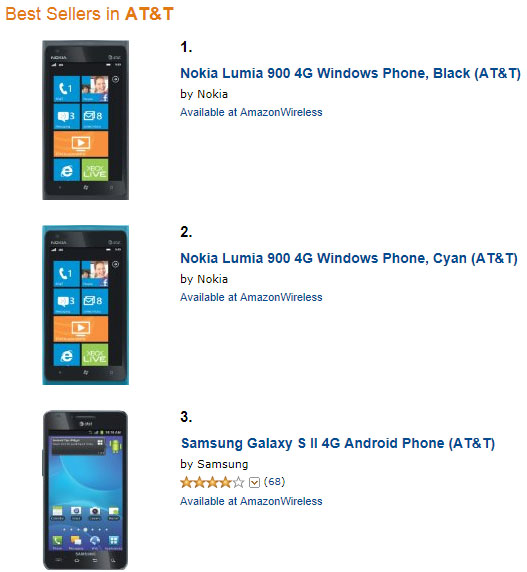
As you can see in the image above (and at the source link below), we not only have one, but two Nokia Lumia 900 phones on the top spots of Amazon's best-selling AT&T devices. Both the black and cyan variants rule the list and this is just three days after the official pre-orders received the green light. Furthermore, Amazon's list of best-selling cell phones with service plans features the two Lumia 900 phones at five and seven. This is great news for both Microsoft and Nokia fans in the U.S.
10:28 0
Nokia 'Smartphone Beta Test' Campaign Targets Competitor

At a first glance, there's no indication that we're looking at an official Nokia website. However, if you take a closer look at the top left, you can almost see the Nokia logo under that black chalk. That, and some references to Nokia's website found inside the web page's code by WPCentral.
On to the content: there are three videos, Exhibit A, B and C, where a certain phone that is losing signal is referenced, another one (or the same, really) which has its screen all washed out in the sun and a third one which seems to be too fragile. You'd be inclined to immediately think Apple but then again a question should immediately follow up: why is everyone picking on Apple? (yes, Samsung too). But then again, it might not be all anti-Apple.
Regardless, the campaign (if it turns out to be one, which wouldn't surprise us with lots of cash and brilliant minds at Nokia) is both funny and serious at the same time, but definitely a great one. Check it out at the source link below and let us know of your comments!
10:20 0
T-Mobile Apologizes For Mistakenly Sending Notification Bar Ads

After the word got out, T-Mobile made an official statement, via e-mail and from a spokesperson, saying that the advertisement was a mistake and that the carrier is sorry for any inconveniences it might have caused. The wording goes like this: "during a recent software update, a message to promote T-Mobile's free VIP Zone was mistakenly sent to certain customers and appeared on the notification bar for some Android devices. After T-Mobile was made aware of this mistake, the company stopped the notifications. T-Mobile apologizes for the inconvenience this may have caused customers".
With most of Google's revenue coming from ads, do you see a possible future where ads would be delivered, in a similar way, to your mobile device (and not only in free, ad-supported applications)?
08:49 0
Inscription à :
Articles (Atom)


