
Affichage des articles dont le libellé est smartphones. Afficher tous les articles
Affichage des articles dont le libellé est smartphones. Afficher tous les articles
vendredi 11 mai 2012
Why Microsoft Is Being Left in the Dust

There are now a number of companies — Apple, Google, Amazon, and others — that have Microsoft in their rear-view mirrors, disappearing quickly on the horizon in a cloud of dust.
That kick of dust in the company’s face is being emitted by Apple’s iPhone and iPad, Amazon’s Kindle, and Google’s search and cloud domination. Microsoft’s own wild lunges into various technology segments are also contributing considerably to it being left behind. Take the company’s recent partnership with Barnes & Noble, where it took 18% of the Nook e-reader for $605 million in cash and future guarantees. This was a move to compete with Amazon, but can it really compete?
If you want to know why Microsoft’s share price has been flat for 11 years while Apple, Amazon, and Google shares have soared, this is why. Microsoft is not innovating aggressively. It is not leading categories or blazing trails. No, it’s acquiring aggressively as a shortcut to innovation. That isn’t working. Its own history suggests as much.
Microsoft Has Not Capitalized on its Partnerships and Acquisitions
Last year, Microsoft announced a broad strategic partnership with Nokia, presumably to use Windows operating systems and software on Nokia’s smartphones. This was 15 months ago. But last week, a report found that Apple and Samsung generated 99 percent of the profits in the mobile phone category. Nokia, which once enjoyed more than half of all mobile phone profits, made zero.
In 2009, Microsoft acquired a 10-year license to use Yahoo’s core search technology, which later became the Bing search engine. Today, Google’s search market share is a dominant 66%, with Microsoft’s Bing a very distant second at 15%. After spending billions building and marketing Bing, Microsoft is barely visible in Google’s rear-view mirror.
Finally, what of Microsoft’s Skype acquisition a year ago? It’s too early to tell, but here’s a fact worth noting: The Wall Street Journal reports that 85% of Microsoft’s revenue comes from Windows and Office software. The rest of it? Barely a blip.
And so, Microsoft is proving, like many have before it, that acquiring companies outside your core competencies are recipes for failure. Remember when Cisco purchased the Flip video camera, at the time one of the most popular consumer electronics products on the planet? How did that work out? In 2010, HP bought Palm for $1.2 billion, but we haven’t seen any industry-altering smartphones from HP.
Conversely, consider Apple’s acquisition of Siri: a technology that immediately and profoundly complimented and enhanced its iPhone. It fit obviously and very successfully.
Microsoft Does Not Need to Compete with Amazon
Another major problem with Microsoft’s partnership involving the Nook is that there is simply no need for it to compete with Amazon. This is like Best Buy focusing all of its efforts on its ecommerce site while neglecting its one major competitive advantage: its brick-and-mortar stores. This is also like Research in Motion spending a year building its atrociously received tablet, the PlayBook, while neglecting its core competency of Blackberry smartphones.
Microsoft dominates the competition in computer operating systems and software. Computers are dying, right? And yet, in May 2012, there is no Microsoft Office for tablets and smartphones. Millions of iPads and Android tablets are being adopted in corporate environments, and most of those customers would be happy to spend $70 on Microsoft Office for each device. Except, it does not exist.
I can only guess why: because with its many categories, acquisitions and partnerships, Microsoft is physically incapable of putting its full focus behind converting its desktop products to mobile devices.
Microsoft is Going Wide, Not Deep
Which brings me to the third and final big problem with Microsoft’s Nook play. It is keeping with the strategy of going as wide as possible. Microsoft is not, and cannot be, all things to all people. In fact, no company can.
Here’s the truth: The wider you go, the more priorities you focus on, the less chance you have to be successful. But when you go deep, you can dominate. (See Apple, and Amazon.) When you go deep, you can continue perfecting. You become the world’s expert on a certain specialty. Apple is seen as the world’s expert on smartphones and tablets. Amazon is the accepted leader in online shopping and electronic reading. It’s because these two companies relentlessly focus on their strengths, saying no to nearly everything else. No. That’s a word Microsoft should consider trying out before it gets left in the dust permanently.
12:05 1
mercredi 9 mai 2012
Today’s Top Stories: Mark Zuckerberg’s Hoodie, Sony’s Powerful LTE Smartphones

Mark Zuckerberg’s Hoodie a “Mark of Immaturity”
Mark Zuckerberg went to a meeting in New York on Monday with potential investors wearing a hoodie, and analyst Michael Pachter thinks it’s a mark of immaturity. “I think that he has to realize he’s bringing investors in as a new constituency right now, and I think he’s got to show them the respect that they deserve because he’s asking them for their money,” Pachter said in an interview on Bloomberg TV.
Sony Unveils Two LTE Smartphones for the Japanese Market
Sony has unveiled two powerful LTE smartphones to be launched in Japan this summer: The Xperia GX and the Xperia SX. The first smartphone sports a dual core, 1.5GHz CPU, a 13-megapixel camera and a 4.6-inch screen, which makes it one of the most powerful devices in Sony’s lineup.
The Xperia SX is much smaller, with an 8-megapixel camera and a 3.7-inch screen. The device weighs only 95 grams, and Sony claims it’s the lightest LTE device in the world right now. Both devices will launch with Android 4.0.
Twitter Debunks Hacking Claims
Reacting to the claims that 55,000 Twitter accounts have been hacked with users’ credentials posted online, Twitter said those claims are largely false. Those accounts are mostly duplicates, Twitter claims, or contain the username and password information for suspended spam accounts.
11:10 0
HTC EVO 4G LTE Comes to Sprint May 18 for $199

The device sports a 4.7-inch HD 720p Super LCD display, a 1.5 GHz dual core CPU, an 8-megapixel camera on the rear plus a 1.3-megapixel one on the front and Android 4.0.
Other features of note are Beats Audio support, a 2000mAh battery and a kickstand for longer video viewing sessions.
Although one of the device’s selling points is support for fast data transfer via LTE, users will have to wait a while to start enjoying it. Sprint plans to launch its LTE network mid-2012, with Atlanta, Baltimore, Dallas, Houston, Kansas City and San Antonio being the first cities to get it.
The HTC EVO 4G LTE can be pre-ordered from Sprint over at www.sprint.com/evo4glte.
11:06 0
mardi 1 mai 2012
RIM Demos BlackBerry 10, Offers Look Into Developer Hardware

RIM's Thorsten Heins took the stage at BlackBerry World to show the audience some of what BlackBerry 10 will have to offer. He highlighted a new virtual keyboard, which considering the relative absence of hardware keyboards on rumored BB10 devices, is going to be hugely important to the system's acceptance. The company's design is all about gestures, using finger-swipes to choose predicted words and shift between keyboard layouts. Other highlights of the operating system include a graphical multitasking interface, again looking to gestures to let you swipe aside the current app and peek at what's running underneath.
As for the BB10 developer hardware, some details continue to remain elusive, but the bigger picture is coming together. RIM's confirmed the handset has a 4.2-inch 720p display. Supposedly, there's also a gigabyte of RAM and 16GB of internal flash storage. We're still wondering just what processor RIM chose to employ.
09:33 0
mardi 10 avril 2012
Following Apple’s and Google’s Lead, Amazon Enables In-App Purchases

The move gives the developers an opportunity to earn more money through in-app upgrades, expansions, subscriptions (essential to publishers) and virtual good purchases. It also makes Amazon’s Appstore more competitive with Apple’s and Google’s app stores, both of which have enabled in-app purchasing since spring 2009 and spring 2011, respectively.
Like Apple and Google, Amazon will keep 30% of all revenue generated through in-app purchases.
Developers and publishers including Disney, Gameloft, G5 Entertainment, Conde Nast and Dow Jones were given early access to Amazon’s in-app purchasing API, and will begin offering in-app purchases Tuesday. In a statement, Larissa McCleary, director of marketing at G5 Entertainment, noted that enabling in-app purchases upped conversion rates and revenue in all of the games G5 offers in the Amazon Appstore.
In-app purchases are becoming an increasingly important source of revenue for developers. According to a study conducted by IHS, in-app purchases generated $970 million in revenue in 2011, accounting for 39% of all smartphone app revenue that year. Those figures are only expected to grow, bringing in $5.6 billion — 64% of all smartphone app revenue — in 2015.
Amazon released the above video to introduce developers to its new, in-app purchasing service.
16:27 0
Microsoft and Nokia Begin Massive Marketing Push Behind Lumia 900
On the heels of putting on a free Nicki Minaj concert in Times Square on Friday, the big marketing push behind the Lumia 900 smartphone went into high gear this week in New York City.
To draw attention to the Nokia Lumia 900 — the first U.S. Windows Phone to boast a high-speed LTE network connection — Microsoft set up an event in Madison Square Park on Monday to give people a chance to check out the new device. The Lumia 900 (which costs $100 with a two-year contract) debuted on Easter Sunday and is yesterday was listed as the number one smartphone on Amazon.
Nokia and Windows aim to differentiate the device in the marketplace by highlighting its LTE network connection, which is far faster than the iPhone’s speed capabilities. New Yorkers who participated in a two-minute demo of the new Lumia 900 device or HTC Titan II device, which also runs on the LTE network, were given a ticket to win “time-saver” prizes.
Those randomly awarded special tickets could tap on an enlarged Lumia 900 touchscreen and win prizes that save them time, from a gift certificate for a local dog walker or having a member of the event staff wait in line for them at popular burger joint Shake Shack, located behind the event space.
“Since the LTE network is so fast, the event focuses on how the Lumia 900 saves you time with its fast speeds,” an event coordinator told Mashable. “It’s been a big success so far.”
An event employee with a microphone also told people in the park that the device runs “much faster than the iPhone” and that it’s the best phone on the market. Although the device launched on Sunday, it was reportedly difficult to purchase the Lumia 900 as nearly all 39 AT&T stores located near Times Square were either closed for Easter Sunday, according to the New York Times.
To create buzz for the launch, Nokia hired Nicki Minaj to put on a free live show in the middle of Times Square on Friday. She performed several songs on a Nokia-branded stage, surrounded by billboards that also promoted the new device. In addition to shout outs about Nokia and the Lumia 900, Minaj also filmed a remix of her song hit “Starships” that has already been watched more than 300,000 times on YouTube. Minaj also promoted her new album “Pink Friday: Roman Reloaded.”
In addition, Nokia launched last week a nationwide marketing campaign called smartphonbetatest that lead up to the launch. The strategy implied that other smartphones were only in beta before the launch of the Lumia 900. However, the site appeared to suffer from poor planning — it counted down to zero several times before launch day, only to have more hours added to the clock each time.
Hands on the Lumia 900
Microsoft set up an event in Madison Square Park on Monday to give people a chance to test the new Lumia 900 smartphone.


Lumia 900 Marketing Event in New York City
The phone --
manufactured by Nokia and powered by Windows software -- aims to
differentiate the itself by highlighting its ultra-fast LTE network
connection.


Window's HTC Titan II Smartphone
Testing the HTC Titan II device, which also runs on the LTE network.


15:48 0
lundi 2 avril 2012
Nokia Lumia 900 Tops Amazon's Best-Selling AT&T Phone Chart
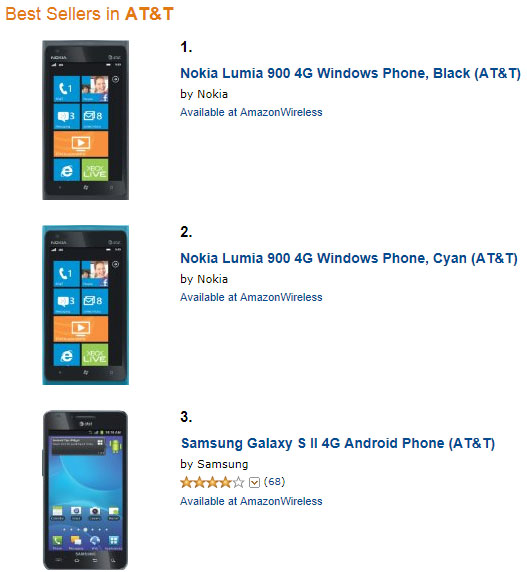
As you can see in the image above (and at the source link below), we not only have one, but two Nokia Lumia 900 phones on the top spots of Amazon's best-selling AT&T devices. Both the black and cyan variants rule the list and this is just three days after the official pre-orders received the green light. Furthermore, Amazon's list of best-selling cell phones with service plans features the two Lumia 900 phones at five and seven. This is great news for both Microsoft and Nokia fans in the U.S.
10:28 0
Nokia 'Smartphone Beta Test' Campaign Targets Competitor

At a first glance, there's no indication that we're looking at an official Nokia website. However, if you take a closer look at the top left, you can almost see the Nokia logo under that black chalk. That, and some references to Nokia's website found inside the web page's code by WPCentral.
On to the content: there are three videos, Exhibit A, B and C, where a certain phone that is losing signal is referenced, another one (or the same, really) which has its screen all washed out in the sun and a third one which seems to be too fragile. You'd be inclined to immediately think Apple but then again a question should immediately follow up: why is everyone picking on Apple? (yes, Samsung too). But then again, it might not be all anti-Apple.
Regardless, the campaign (if it turns out to be one, which wouldn't surprise us with lots of cash and brilliant minds at Nokia) is both funny and serious at the same time, but definitely a great one. Check it out at the source link below and let us know of your comments!
10:20 0
T-Mobile Apologizes For Mistakenly Sending Notification Bar Ads

After the word got out, T-Mobile made an official statement, via e-mail and from a spokesperson, saying that the advertisement was a mistake and that the carrier is sorry for any inconveniences it might have caused. The wording goes like this: "during a recent software update, a message to promote T-Mobile's free VIP Zone was mistakenly sent to certain customers and appeared on the notification bar for some Android devices. After T-Mobile was made aware of this mistake, the company stopped the notifications. T-Mobile apologizes for the inconvenience this may have caused customers".
With most of Google's revenue coming from ads, do you see a possible future where ads would be delivered, in a similar way, to your mobile device (and not only in free, ad-supported applications)?
08:49 0
Sprint Galaxy Nexus Launch Rumors Look To New, Later Date

As far as visually convincing leaks go, this find leaves a lot to be desired. Just a basic word processor document, it does little to try and convince us it's an official internal publication. That said, if we're to have a little faith here, the leak suggests that the LG Viper will, in fact, launch on April 15 as we'd heard, but the Galaxy Nexus won't hit stores for another week after at, finally landing on April 22.
Sprint and HTC have an event planned for Wednesday, and while we don't expect to hear anything about the Nexus directly, Sprint may offer a little insight while discussing its general LTE launch plans.
08:30 0
lundi 5 mars 2012
LG Optimus Vu Goes Up For Sale As Pricing Info Revealed

Sales of the Optimus Vu begin today in Korea. If you go to check out the Android at a retailer, make sure you bring a high-limit credit card, because off-contract sales of the Vu work out to the equivalent of nearly $900.
There are plenty of good reasons why smartphones are so expensive, and we could probably live with a price that was just a hundred dollars or so cheaper, but it really starts to get difficult rationalizing the sticker price as we approach the $1000 mark.
From its specs, it sounds like the Vu could be a very solid phone, and though it's not for everyone, we're sure that the unusual size and shape will win it a few big fans. Unless LG makes the handset more affordable as it spreads to additional markets around the globe, though, it could be difficult to convince consumers to give the Vu a chance.
15:22 0
mercredi 22 février 2012
Google Heads-Up Display Glasses Are Coming by the End of 2012 [REPORT]
 Google plans to launch glasses with a heads-up display by the end of 2012, the New York Times reports citing sources familiar with the matter.
The glasses, who were previously rumored to have a front-facing camera with flash and a voice input interface, will be Android based, sources say.
They will include a display, mere inches from the wearer’s eye, streaming real-time info about your surroundings, similar to the various augmented reality applications we’ve seen on smartphones.
The data will be fetched through a 3G/4G data connection, and the glasses will retrieve information about their surroundings through GPS and several sensors.
The glasses will cost “around the price of current smartphones,” sources say. While definitely not very precise – current smartphones cost anywhere from $150 to $600 – this price range shows that Google intends the glasses as a product for the mass market.
Will these glasses be something you need as opposed to want? We doubt it – we haven’t seen a must-have augmented reality application yet, although we have seen some very cool ones in the past.
AR heads-up display glasses, however, are the stuff sci-fi dreams are made of, and it’s a product we’d definitely like to see in the real world – even if they make us look like total geeks.
Image courtesy of Flickr, Jason McDermott.
[via New York Times]
08:21 0
Inscription à :
Articles (Atom)


