
Affichage des articles dont le libellé est new. Afficher tous les articles
Affichage des articles dont le libellé est new. Afficher tous les articles
vendredi 11 mai 2012
Facebook’s New App Center: Everything You Need to Know

Instead of selling apps that integrate with Facebook, the new App Center will refer users to other app stores where they can buy them.
Confused? You’re not the only one. After Facebook announced the new feature on Wednesday, “I don’t get it” was a common response.
We’ve answered below some of the most common questions about how the App Center will work, what apps it will contain and why Facebook built it. Let us know if you have another question we missed.

So Facebook is going to have an app store now?
Yes, but not in the same sense that Google and Apple have app stores. What Facebook has announced is more of an app showcase. In addition to apps built on Facebook, it includes apps that use Facebook Login, regardless of whether they’re iOS, Android or web apps.
Does that mean I can buy iOS and Android apps on Facebook?
No. Though you will find iOS and Android apps in the App Center, you will be directed to Apple’s App Store or Google Play to actually download the apps.
Facebook announced on Wednesday that it will allow developers to charge for “apps built on Facebook” for the first time, but is not clear whether users will purchase apps directly from the App Center.
What are “apps built on Facebook,” and how are they different than iOS and Android apps that integrate with Facebook?
Apps built on Facebook are web apps viewed and used within the Facebook site. They get a special page within Facebook where they load. On the other hand, apps with Facebook integrations such as Draw Something and Pinterest are built on external platforms, but they interface with Facebook for login and other social features.
Couldn’t I spend money on apps built on Facebook before?
Yes. Previously, Facebook has allowed in-app purchases within these apps, but it has not allowed developers to charge for apps themselves.
Social game maker Zynga, for example, has previously been able to charge for items like blueberries or game advantages within Farmville. Now it will have the option to charge for Farmville itself.
How will I access Facebook’s App Center?
Facebook’s App Center will launch on the web as well as within the iOS and Android Facebook apps.
What will the App Center Look Like?
It will look a lot like Google Play or the Apple App Store. Each app will have a detail page, which includes a five-star user-rating system. A screenshot of the prototype that Facebook engineer Aaron Brady included in a blog post about the center includes sections for recommended apps, friends’ apps, top apps, trending apps and top-grossing apps.
“We use a variety of signals, such as user ratings and engagement, to determine if an app is listed in the App Center,” Brady wrote.
Hasn’t Facebook launched something like this before?
Sort of. When Facebook first launched Facebook apps in 2007, there was a dedicated applications area where users could browse apps from third-party developers. Users currently locate Facebook apps through the same search bar they use to find people, groups and events.
Why would Facebook launch something like this?
As Brady put it in his blog post, “The App Center is designed to grow mobile apps that use Facebook — whether they’re on iOS, Android or the mobile web.”
Facebook wants developers to build mobile apps that integrate it. Reaching Facebook’s 900 million users through the App Center is another incentive for them to do so.
The showcase also encourages makes it easier to discover apps built on Facebook, many of which integrate Facebook’s payment system Credits. All games built on Facebook are required to use Facebook Credits to accept payments (except when they’re running on iOS), and Facebook takes a takes a 30% cut of all purchases made with Facebook Credits. That’s why as of February Zynga accounted for 12% of the social network’s revenue.
Facebook will also presumably take a 30% cut of the purchase price for upcoming paid apps built on Facebook.
12:12 1
dimanche 6 mai 2012
What’s America’s Most Engaging Social Network? You’ll Be Surprised

Tagged users visited an average of 18 times each during March according to ComScore, second only to Facebook’s average of 36 visits per vistor. And each time a Tagged user visited the site, he or she stuck around for 12.1 minutes — which trailed only Tumblr (14.7 minutes) and beat out Facebook (10.9 minutes).
Tagged co-founder and CEO Greg Tseng says he’s happy about ComScore’s March data, but that his company has been among America’s most engaging social networks for about a year now. The secret to Tagged’s success? A pivot Tseng and co-founder Johann Schleier-Smith made around the beginning of 2008.
The longtime friends started Tagged in 2004, at the time angling it to be a Facebook-like social network for high schoolers. Eventually, however, Facebook expanded beyond a closed college network and allowed anyone over the age of 12 to join.
“We took a hard look and decided we weren’t going to win,” Tseng says. “But we had found out a lot of our users were actually using Tagged to meet new people, so that led us to pivot into a new space called ‘social discovery,’ where people use sites to make new social relationships.”
As opposed to sites like Facebook, where people primarily organize and maintain relationships established offline, Tagged functions mostly as a portal to meet new people online for romance or simply friendship. The site’s algorithms encourage users to connect based on shared interests, tastes and hobbies.
Tseng says Tagged’s 10 million core monthly active users form an average of 100 million new connections per month. The site has been profitable since 2008, and over the past year tripled its staff to a current count of more than 170.
With social discovery as a whole seen by many to be a rising tide, Tseng believes Tagged’s success will continue to grow.
“If I look out at the next five or 10 years, I really see social discovery as big as social networking — in some sense I think you can think of social discovery as the engine for social networking,” he says, referencing Dunbar’s number, which theorizes that humans can maintain an average of 150 connections at a time.
“Facebook is the place where you maintain your current 150,” he says. “And Tagged will be the place where you refresh that 150.”
Do you think social discovery is the next big thing? Let us know in the comments.
09:45 0
mercredi 2 mai 2012
Bing Takes on Google With Simple New Design
Microsoft’s search engine Bing
has done some heavy spring cleaning as a part of an effort to
de-clutter its search result pages — and the new design looks a lot like
Google.
Bing rolled out a new look that is designed to help users get results faster than ever. But the seamless design bears a striking resemblance to Google Search’s simple layout. See below.
 “Over the past few months, we’ve run dozens of experiments to
determine how you read our pages to deliver the link you’re looking
for,” Sally Salas, principal group program manager at Bing, said on its official blog.
“Based on that feedback, we’ve tuned the site to make the entire page
easier to scan, removing unnecessary distractions, and making the
overall experience more predictable and useful.”
“Over the past few months, we’ve run dozens of experiments to
determine how you read our pages to deliver the link you’re looking
for,” Sally Salas, principal group program manager at Bing, said on its official blog.
“Based on that feedback, we’ve tuned the site to make the entire page
easier to scan, removing unnecessary distractions, and making the
overall experience more predictable and useful.”
In addition to faster page-load times and more relevant search results, Bing tightened the header and removed the “left rail” related-search section, making it easier to find the information and links you want.
It also enlarged the space between lines to increase readability and optimize the page for touch devices.
Bing said it is working on updating its search page even more in the future.
“We’re not finished, ” Salas wrote. “Today, we’re also testing out some new ideas for the homepage, including a larger version of the popular daily image. If you happen upon the homepage changes, please let us know what you think.”
What do you think of Bing’s new search results page? Do you think the site looks too much like Google? Let us know in the comments.
Bing rolled out a new look that is designed to help users get results faster than ever. But the seamless design bears a striking resemblance to Google Search’s simple layout. See below.
In addition to faster page-load times and more relevant search results, Bing tightened the header and removed the “left rail” related-search section, making it easier to find the information and links you want.
It also enlarged the space between lines to increase readability and optimize the page for touch devices.
Bing said it is working on updating its search page even more in the future.
“We’re not finished, ” Salas wrote. “Today, we’re also testing out some new ideas for the homepage, including a larger version of the popular daily image. If you happen upon the homepage changes, please let us know what you think.”
What do you think of Bing’s new search results page? Do you think the site looks too much like Google? Let us know in the comments.
12:28 1
mardi 27 mars 2012
Viralheat Adds Social Media Publishing With Version 2.0,

One of the biggest changes in version 2.0 is a new feature that Viralheat is calling engagement, and which basically means you can post comments to Facebook and Twitter directly from the service. Posting to social networks may not sound like a big deal, but CEO Raj Kaddam says it makes life a lot easier for customers.
Instead of using one tool (such as, well, Viralheat) for monitoring social media mentions and sentiment, then jumping to a different application (such as CoTweet) to actually publish content, Viralheat allows you to do both in one place. Wherever you are in the service, there’s a button at the top right that lets you post to social networks. When you’re reading through Facebook and Twitter comments, you can hover over them to get more details about the commenter, then click to respond directly.
Viralheat 2.0 also refreshes the product’s user interface to one what Kaddam says is “more of an inbox-type layout.” One of the big goals, he says, was to make it easy to access all of Viralheat’s reports with fewer clicks. And the upgrade also incorporates Facebook Insights, giving companies more information about the conversations on the Facebook Pages, and more data from Twitter.
The company’s investors include Mayfield Fund. You can see a demo of the new version below.
10:30 0
lundi 19 mars 2012
Why Apple Is Giving Cash Back to Shareholders

There are several reasons Apple is giving dividends, but the primary one is that investors feel they have a right to some of Apple’s $100 billion. “People expect a return on their investment,” says Charles Elson, director of the John L. Weinberg Center for Corporate Governance at the University of Delaware. “If you can’t do anything with the money, then you should give it back.”
Elson says that Apple is not the only company to deal with this issue. At some point, every successful public company will get pressure to give money back. (Before the recession, Exxon Mobil, Dell and Pfizer, among others, got the same kind of pressure from investors to give back their cash or find a way to invest it.) In Apple’s case, closing in on $100 billion seems to have triggered a call to launch a dividend for investors, but there’s usually no benchmark for such decisions. “It’s all up to the judgment of the board,” says Elson.
Tim Bajarin, president of Creative Strategies, says $100 billion is way more than Apple needs, so it doesn’t make sense to keep all that money on hand. He points out that even after the company pays out its $45 billion in dividends, Apple will still have more than $50 billion in cash plus whatever it puts aside in the future. “They’ll always have cash for even big acquisitions if it enhances their position,” says Bajarin, who expects Apple to start buying more companies.
During the call with analysts Monday morning, Apple CEO Tim Cook repeatedly stressed that the dividend would also attract new investors. With a share price of $600, drawing new shareholders doesn’t seem like an issue, but Bajarin notes that there’s a type of investor that is primarily concerned with dividends. “Most of the guys buying [Apple stock] today are buying on a holding basis,” says Bajarin, who notes that such investors believe Apple is a good long-term buy. “But there are a lot of people who buy stock only on a monthly basis.”
Another point Bajarin emphasized is that some 65% of of Apple’s cash is based outside the U.S. Merely bringing that money — now housed in foreign banks — back to the U.S. would force Apple to lose cash in taxes and other fees. “Apple’s not the only one,” he says. “No corporation wants to bring money back to the U.S.”
Known for its dramatic product introductions, Apple’s Monday morning announcement will probably seem ho-hum for non-investors. But, based on Apple’s stock performance Monday morning, the company has at least prompted a squib of excitement among its intended audience: At press time, the company’s stock was up about $6 or 1% at the iDividend news.
The New iPad Details Hit Apple.com
The new 9.7-inch iPad
has 2048 x 1536-pixel retina display, 5-megapixel camera (with the same
optics sensor from the iPhone 4S) and 1080p video recording. It is
available March 16 in black and white, powered by A5X chip (with
quad-core graphics) and supports 4G LTE networks. It's 9.4 millimeters
thick and 1.4 pounds.Wi-Fi only iPads cost $499 for 16 GB, $599 32 GB and $699 for 64 GB, while 4G versions cost $629 for 16 GB, $729 32 GB and $829 for 64 GB. Pre-orders start today, and the devices will be in stores March 16 in these 10 countries: U.S., UK, Japan, Canada, Switzerland, Germany, France, Hong Kong, Singapore and Australia.
Credit: Apple.com

Apple.com Touts New iPad Features
"Pick
up the new iPad and suddenly, it’s clear. You’re actually touching your
photos, reading a book, playing the piano. Nothing comes between you
and what you love. To make that hands-on experience even better, we made
the fundamental elements of iPad better — the display, the camera, the
wireless connection. All of which makes the new, third-generation iPad
capable of so much more than you ever imagined."Credit: Apple.com

09:15 0
jeudi 8 mars 2012
This Article Generating Thousands Of Dollars In Ad Revenue Simply By Mentioning New iPad

12:57 0
mercredi 22 février 2012
Sony Launches New Sony Mobile Website, Kills SonyEricsson.com
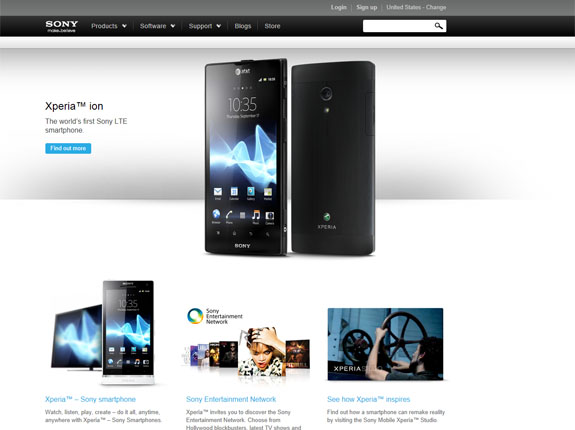
After we posted "Sony Ericsson Dead, Long Live Sony Mobile Communications" we should have seen this coming as sonyericsson.com is history and the new sonymobile.com is taking its place.
It will take a little bit of getting used to it but the new website seems to borrow the main design principles of Sony's main web page. The AT&T Xperia Ion is greeting you on the front page of the American website while the Xperia S is featured as you enter the U.K. page. According to reports, @SonyXperia is the new Twitter handle to follow once it will be up in place and working, as implied in the press site.
08:47 1
mercredi 8 février 2012
Foursquare Rolls Out New Version Of “Explore” On Mobile With Filters & Improved Search

After updating your mobile app, you’ll see the improvements in the “Explore,” section, Foursquare’s local guide which is augmented by your friends’ recommendations and visits as well as other Foursquare users’ tips and comments. Like a mini local search engine, you can search for venues by category (“coffee,” “nightlife”), name, or even something very specific, like what food you’re in the mood for (“tuna,” “burgers”). You can also tap “Specials” to see just those venues offering check-in or mayor discounts.
Starting today, you’ll now be able to use the new filter button (at the top right on iOS or bottom right on Android) to narrow your search results by options like “New to me,” places you’ve already been, “Both,” or, alternatively, you can choose to see those places your friends have tried.
You can also use Explore to find recommended places in areas outside your current location, as determined by your phone’s GPS. You can either type in a location or drag the map around, then pinch or tap to zoom into new neighborhoods.
Although still sometimes overlooked by those who just use Foursquare as a checkin service/social network, Explore represents a key new direction for the location-based startup. The idea, as Foursquare founder Dennis Crowley explained last month when Explore arrived on the web, is to try to “make local search much smarter…it’s based off what you and your friends actually do, where you go and when you go.”
And, for obvious reasons, local search is much smarter when you can actually use it while on the go. The new Foursquare apps are out now, check the appropriate app store for the update.
15:04 0
mercredi 1 février 2012
Firefox 10 Is Here. Is it Worth Your Time?

Yes, rev up your update engines. Firefox 10 — the latest in a dizzying series of upgrades — is now available for your browsing pleasure.
This is Mozilla’s seventh major browser release in the last 10 months. After releasing Firefox 4 in March 2011, Mozilla adopted a rapid release schedule similar to the cycle Google employs with its Chrome browser.
The new schedule means that users get a new version of Firefox every six weeks, rather than every two to three years.
Like other recent releases, Firefox 10 focuses on under-the-hood enhancements and bug fixes, rather than scads of new features or changes to the user interface.
Still, Mozilla has added some new front-facing features to Firefox 10, including improvements to add-on compatibility and built-in developer tools.
Firefox now automatically marks add-ons as compatible with the browser without requiring add-on developers to code support by hand. The browser also automatically checks for add-on updates every 24 hours.
As for the developer tools, Firefox 10 now includes a tightly-integrated set of CSS, HTML and DOM inspectors. This allows web developers to quickly zero in on any portion of a live (or locally hosted) web page and enable real-time previewing.
If you’re familiar with WebKit’s Web Inspector in Safari and Chrome, you’ll feel right at home with Firefox 10′s tool suite. It won’t replace add-ons like Firebug for advanced developers, but it’s a great lightweight, built-in option.
With Firefox 10, Mozilla is offering those users access to what it calls “Firefox ESR,” or Extended Support Release. Organizations that use Firefox ESR will get support and updates for 42 weeks, rather than the standard six. Security updates will still be pushed out on schedule.
13:25 1
dimanche 29 janvier 2012
Twitter's new censorship plan rouses global furor

This screen shot shows a portion of the Twitter
blog post of Thursday, Jan. 26, 2012, in which the company announced it
has refined its technology so it can censor messages on a
country-by-country basis. The additional flexibility is likely to raise
fears that Twitter's commitment to free speech may be weakening as the
short-messaging company expands into new countries in an attempt to
broaden its audience and make more money. But Twitter sees the
censorship tool as a way to ensure individual messages, or "tweets,"
remain available to as many people as possible while it navigates a
gauntlet of different laws around the world. (AP Photo/Twitter)
(AP) -- Twitter, a tool of choice for dissidents and
activists around the world, found itself the target of global outrage
Friday after unveiling plans to allow country-specific censorship of tweets that might break local laws.
It was a stunning role reversal for a youthful company that prides itself in promoting unfettered expression, 140 characters at a time. Twitter insisted its commitment to free speech remains firm, and sought to explain the nuances of its policy, while critics - in a barrage of tweets - proposed a Twitter boycott and demanded that the censorship initiative be scrapped.
"This is very bad news," tweeted Egyptian activist Mahmoud Salem, who operates under the name Sandmonkey. Later, he wrote, "Is it safe to say that (hash)Twitter is selling us out?"
In China, where activists have embraced Twitter even though it's blocked inside the country, artist and activist Ai Weiwei tweeted in response to the news: "If Twitter censors, I'll stop tweeting."
One often-relayed tweet bore the headline of a Forbes magazine technology blog item: "Twitter Commits Social Suicide"
San Francisco-based Twitter, founded in 2006, depicted the new system as a step forward. Previously, when Twitter erased a tweet, it vanished throughout the world. Under the new policy, a tweet breaking a law in one country can be taken down there and still be seen elsewhere.
Twitter said it will post a censorship notice whenever a tweet is removed and will post the removal requests it receives from governments, companies and individuals at the website chillingeffects.org.
The critics are jumping to the wrong conclusions, said Alexander Macgilliviray, Twitter's general counsel.
"This is a good thing for freedom of expression, transparency and accountability," he said. "This launch is about us keeping content up whenever we can and to be extremely transparent with the world when we don't. I would hope people realize our philosophy hasn't changed."
Some defenders of Internet free expression came to Twitter's defense.
"Twitter is being pilloried for being honest about something that all Internet platforms have to wrestle with," said Cindy Cohn, legal director of the Electronic Frontier Foundation. "As long as this censorship happens in a secret way, we're all losers."
State Department spokeswoman Victoria Nuland credited Twitter with being upfront about the potential for censorship and said some other companies are not as forthright.
As for whether the new policy would be harmful, Nuland said that wouldn't be known until after it's implemented.
Reporters Without Borders, which advocates globally for press freedom, sent a letter to Twitter's executive chairman, Jack Dorsey, urging that the censorship policy be ditched immediately.
"By finally choosing to align itself with the censors, Twitter is depriving cyberdissidents in repressive countries of a crucial tool for information and organization," the letter said. "Twitter's position that freedom of expression is interpreted differently from country to country is unacceptable."
Reporters Without Borders noted that Twitter was earning praise from free-speech advocates a year ago for enabling Egyptian dissidents to continue tweeting after the Internet was disconnected.
"We are very disappointed by this U-turn now," it said.
Twitter said it has no plans to remove tweets unless it receives a request from government officials, companies or another outside party that believes the message is illegal. No message will be removed until an internal review determines there is a legal problem, according to Macgilliviray.
"It's a thing of last resort," he said. "The first thing we do is we try to make sure content doesn't get withheld anywhere. But if we feel like we have to withhold it, then we are transparent and we will withhold it narrowly."
Macgilliviray said the new policy has nothing to do with a recent $300 million investment by Saudi billionaire Prince Alwaleed bin Talal Mac or any other financial contribution.
In its brief existence, Twitter has established itself as one of the world's most powerful megaphones. Streams of tweets have played pivotal roles in political protests throughout the world, including the Occupy Wall Street movement in the United States and the Arab Spring uprisings in Egypt, Bahrain, Tunisia and Syria.
Indeed, many of the tweets calling for a boycott of Twitter on Saturday - using the hashtag (hash)TwitterBlackout - came from the Middle East.
"This decision is really worrying," said Larbi Hilali, a pro-democracy blogger and tweeter from Morocco. "If it is applied, there will be a Twitter for democratic countries and a Twitter for the others."
In Cuba, opposition blogger Yoani Sanchez said she would protest Saturday with a one-day personal boycott of Twitter.
"Twitter will remove messages at the request of governments," she tweeted. "It is we citizens who will end up losing with these new rules ... ."
In the wake of the announcement, cyberspace was abuzz with suggestions for how any future country-specific censorship could be circumvented. Some Twitter users said this could be done by employing tips from Twitter's own help center to alter one's "Country" setting. Other Twitter users were skeptical that this would work.
While Twitter has embraced its role as a catalyst for free speech, it also wants to expand its audience from about 100 million active users now to more than 1 billion. Doing so may require it to engage with more governments and possibly to face more pressure to censor tweets; if it defies a law in a country where it has employees, those people could be arrested.
Theoretically, such arrests could occur even in democracies - for example, if a tweet violated Britain's strict libel laws or the prohibitions in France and Germany against certain pro-Nazi expressions.
"It's a tough problem that a company faces once they branch out beyond one set of offices in California into that big bad world out there," said Rebecca MacKinnon of Global Voices Online, an international network of bloggers and citizen journalists. "We'll have to see how it plays out - how it is and isn't used."
MacKinnon said some other major social networks already employ geo-filtering along the lines of Twitter's new policy - blocking content in a specific jurisdiction for legal reasons while making it available elsewhere.
Many of the critics assailing the new policy suggested that it was devised as part of a long-term plan for Twitter to enter China, where its service is currently blocked.
China's Communist Party remains highly sensitive to any organized challenge to its rule and responded sharply to the Arab Spring, cracking down last year after calls for a "Jasmine Revolution" in China. Many Chinese nonetheless find ways around the so-called Great Firewall that has blocked social networking sites such as Facebook.
Google for several years agreed to censor its search results in China to gain better access to the country's vast population, but stopped that practice two years after engaging in a high-profile showdown with Chain's government. Google now routes its Chinese search results through Hong Kong, where the censorship rules are less restrictive.
Google Executive Chairman Eric Schmidt declined to comment on Twitter's action and instead limited his comments to his own company.
"I can assure you we will apply our universally tough principles against censorship on all Google products," he told reporters in Davos, Switzerland.
Google's chief legal officer, David Drummond, said it was a matter of trying to adhere to different local laws.
"I think what they (Twitter officials) are wrestling with is what all of us wrestle with - and everyone wants to focus on China, but it is actually a global issue - which is laws in these different countries vary," Drummond said.
"Americans tend to think copyright is a real bad problem, so we have to regulate that on the Internet. In France and Germany, they care about Nazis' issues and so forth," he added. "In China, there are other issues that we call censorship. And so how you respect all the laws or follow all the laws to the extent you think they should be followed while still allowing people to get the content elsewhere?"
Craig Newman, a New York lawyer and former journalist who has advised Internet companies on censorship issues, said Twitter's new policy and the subsequent backlash are both understandable, given the difficult ethical issues at stake.
On one hand, he said, Twitter could put its employees in peril if it was deemed to be breaking local laws.
"On the other hand, Twitter has become this huge social force and people view it as some sort of digital town square, where people can say whatever they want," he said. "Twitter could have taken a stand and refused to enter any countries with the most restrictive laws against free speech."
13:11 0
mercredi 25 janvier 2012
Is Manufacturing the New Black?

Take, for instance, New Orleans-based Jolie & Elizabeth, started by Jolie Bensen, 28, and Sarah Elizabeth Dewey, 24, two southern girls who met at BCBG in Manhattan. When the two decided to start their own company, they hit the road for Bensen’s home turf of New Orleans—far from the hyper-competitive fashion scene in New York and Los Angeles. With Bensen as the chief designer and Dewey handling sales and marketing, the two launched their line in the Spring of 2010 with help from a manufacturing partner in New Orleans East. “The factory was really hurt by Katrina and was about to shut down,” recalls Bensen. “We begged them to let us help them.” The owners agreed and the young partners got cracking on their first line.
Today, says Bensen, Jolie & Elizabeth, which makes feminine, functional dresses with a Southern-girl flair, is “one of the only completely vertically integrated clothing companies in the South.” The company has six-figure revenues, a growing network of retailers and, say the partners, a strong commitment to remaining in New Orleans—where their dresses now account for 45 percent of production at their manufacturing facility. “At BCBG, we saw that if you wanted to change something minor, you just couldn’t get it done,” says Bensen, referring to the downside of manufacturing overseas. “And if they make a mistake, then you get 700 of the wrong dress.” Bensen and Dewey, on the other hand, are at their factory almost every day to keep a close eye on production. If a button needs to be moved, or the length of a sleeve changed, then adjustments can be made without the communications snafus that frequently come with distant partners.
From a brand and marketing standpoint, the company’s New Orleans roots give it a strong point of differentiation. “We have a 'Made in Louisiana' label in every dress, and that’s one of our best sales strategies,” says Dewey. “We sell to some boutiques that only carry products made in the U.S., and I think we’ll see more and more retailers favoring goods made here.” Jolie & Elizabeth dresses are now carried by 30-plus retailers and revenue for their fall and winter collection doubled over last spring. Bensen and Dewey also speak frequently to girls at southern high schools and universities, hoping to spread the word that the south is a great breeding ground for young designers, and that manufacturing at home helps build local economies.
07:46 0
Inscription à :
Articles (Atom)


