
lundi 5 mars 2012
Business Taxes Decoded 2012

The Best States for Business
While no business owner can expect to escape taxes entirely, there are states where taxes are lower than in most places.
Should a Small Business Do Its Own Taxes?
Maybe. It depends on a variety of factors. Here's what you need to consider.
3 Things to Remember When Filing Your Taxes for the First Time
Filing business taxes for the first time? Don't fret. Just remember to do these three things.
How to Minimize What You Owe and Maximize Your Return
Twenty-six-year veteran small-business accountant Frank Gutta gives his expert advice.
How to Choose an Accountant You Can Trust
Be sure to ask these four pertinent questions when interviewing your potential adviser.
3 Most Common Mistakes Made When Filing Business Taxes
No matter how you get your taxes done, steer clear of these common mistakes that are made year after year.
10 Things You Didn't Know About Your Taxes
Mike Scholz, tax director of a Wisconsin accounting firm, shares some tax tips for small-business owners.
Top 5 Tools for Filing Business Taxes
Here's our roundup of tools small businesses can use to file their business taxes.
Are You Really Inviting an Audit If Your Office Is In Your Bedroom?
Contrary to popular belief, deducting the cost of your home workspace doesn't call for an automatic audit from the IRS.
The Future of Online Sales Tax
Billions of dollars in taxes on e-commerce transactions go uncollected every year. But that may soon change.
Planning Ahead: 5 Ways to Save Money on Your 2012 Taxes
It's already time to prepare for next year's taxes. Tax expert Barbara Weltman shares some money-saving tips for 2012.
Infographic: A Snapshot of Business Taxes in the U.S.
Curious about how your business taxes compare to your industry's average? Our infographic sheds light on that and more.
Kalina Mazur is the executive editor of OPEN Forum.
14:29 0
dimanche 4 mars 2012
From Zynga To Flipboard: Why All Eyes Are On China For The Next Mobile Boom

If you spend any time speaking with Western mobile companies, one topic that’s likely to pop up is their “China strategy.” Due to a mix of mobile penetration, sheer population, and popularity of the mobile web, Western mobile companies recognize there’s a lot of money to be made overseas.
The idea is not without merit: China is the world’s largest mobile market with almost one billion users, 69 percent of which access the Internet through their phones on a regular basis. As such, plenty of big-name Western mobile companies have already begun entering China. However, the mobile market is still immature with issues like fragmentation and piracy, making distribution exceedingly difficult for developers. China isn’t quite yet a home away from home for Western developers, but it’s poised to be the next big mobile market.
China’s lucrative potential is especially relevant for mobile developers. Mobile apps and games were popular in China well before the United States caught on, and the market is only going to get bigger. Smartphone adoption is picking up and opening a window for Western developers to introduce new titles, while in-app purchases are on the rise in China and app downloads have almost tripled in the last year (more on that in a second).
Rise of the Smartphones
China has over 980 million mobile users. While this number is staggering, the majority of users own feature phones. As such, many local developers create apps that cater to feature phones. However, in the past few years, smartphone adoption — both iOS and Android devices — has increased significantly. According to research firm Strategy Analytics, almost 24 million smartphones were shipped to China in 2011, surpassing the number of devices in the U.S. This trend is still gaining steam and creating a profitable window for Western iOS and Android app and game developers. The9 and GREE recognized this trend early and established the $100 million Fund9 to help developers port their games to Android and distribute them in China.
Loads of Downloads
In addition to a massive user base, China’s mobile activity is also skyrocketing. More people are downloading more apps and games. According to mobile analytics site App Annie China’s mobile download numbers have grown by almost 300 percent in the last year. Additionally, research firm Distimo reported that over 30 percent of Apple’s App Store downloads were coming from China by the end of 2011, as opposed to only 18 percent at the beginning of that year.
In-App Purchases and Virtual Goods
China’s massive mobile potential is more than just a numbers game. It’s true that there are more mobile users in China than anywhere else, but they’re also starting to spend more. A lot more. According to App Annie, mobile revenue in China has nearly tripled in the last year, increasing by 187 percent. This is partially due to Apple’s recent announcement that they’re going to start accepting App Store payments in Chinese yuan. Now Western game developers can seamlessly offer virtual goods to China’s huge audience.
Western mobile companies can’t afford to ignore the Chinese market. A good example of this is Flipboard. Before launching in China, Flipboard was plagued by multiple clone apps that grew in popularity in the app’s absence. Since launching in China’s App Store, the company has been successful partnering with big-name companies like Sina and Renren. Hit mobile game maker, Rovio, saw a similar problem with loads of unlicensed Angry Birds (even a theme park) being sold in China. Their solution: open an entire Angry Birds store in China.
There’s more incentive to enter China than just to protect a brand. Companies like CrowdStar, GREE, and Zynga have all announced China ambitions.
As China’s mobile market continues to mature, it’s safe to assume that issues like piracy and fragmentation will become less problematic. For mobile game developers looking to cash in on China today, there are still some ways they can bring their apps over successfully. Finding a local partner to help with distribution, security, and catering to a Chinese audience will ensure a more successful launch.
Companies like The9 recognize both China’s complexity and its opportunity, and are eager to work with Western app developers. By leveraging carrier partnerships and working with multiple distribution channels, local partners can eliminate the headache of entering China.
Developers also need to localize their apps if they want them to succeed in China. This means not only translating apps into Chinese, but also customizing design aspects to meet cultural preferences and various channel requirements.
China is a beast already and it’s only going to get bigger. As Apple and Google continue to penetrate the market and cater to Chinese audiences, there will be a great window of opportunity for Western developers to rake in the yuan.
[image via flickr/bfishadow]
09:19 0
One Year Later: How Google Panda Changed Our Business
Editor’s note: Matt Moog is the founder and CEO of Viewpoints.com.
Google Panda strikes
February 24, 2011 was a day that will live in infamy for the team here at Viewpoints. That was the day of the Google Panda update. Up until that point we had enjoyed four years of consistent traffic growth to Viewpoints.com. We managed to double traffic each year and had just reached 2.7 million unique users. We had heard that Google was planning to update its algorithm to penalize content and link farms and were excited about the bump we might get as a result. Turns out we were in for a bit of a surprise.
Viewpoints takes it on the chin
You see, Viewpoints is a consumer reviews and product ranking web site. We have 600,000 reviews of 100,000 products contributed by more than 250,000 members. We have had more than 70 million visits to the site since we launched in late 2007. All of our content is original and we always viewed all of our practices as the “right way” to do things. Apparently Google felt differently because we lost 50% of organic search traffic overnight as a result of the Panda update.
And tries some quick fixes
As the days passed and we sorted out all of the comments from Matt Cutts and industry pundits and watched the Google blog as anxiously as the faithful await the plumes of smoke from the Vatican to figure out what we could do to get back in the good graces of the Google crawler. Was it our ad density? Was it speed of our site? Did we not have the right authoritative back links? Was it that some of our reviews were short and Google was penalizing sites with ”thin content”?
The truth of the matter was that it could have been any and all of these. Although we had hundreds of thousands of great reviews, we had probably let some slip through that did not deserve to be published. And we had not paid enough attention to speed, ad density or other hall marks of a good user experience. So we set out to fix our Google problem but at the same time, we resolved to think bigger and longer term and use this opportunity to create a better user experience, regardless of what Google was looking for.
So now you can judge the results for yourself. We have spent the last 12 months as a team of 25+ professionals reinventing Viewpoints. From March to June we removed 40% of the ads across the site. We improved the speed of the site by 3x. We moderated out 80,000+ reviews that did not meet minimum quality standards. Unfortunately these changes had only a nominal impact on traffic. So we decided it was time for a more radical approach.
Time to make serious long-term changes
After making the changes listed above and 90 days after Google’s Panda update, our team decided to devote six months to a total overhaul of the Viewpoints.com user experience. This was not just a visual redesign but a soup-to-nuts, top-to-bottom overhaul. We ended up making 30 major changes to the user experience. This entire effort was basically a bet the company decision. It had been four years since we first launched and the reality is that the world had changed. It was time to question even some of the most fundamental assumptions.
Content Quality – addressing the perception of “thin” content
In addition to eliminating 80,000 reviews that did not meet our new quality standards we also decided to eliminate stand alone review pages for all but the longest reviews. This one decision removed 600,000 pages from the site. We also decided to treat very short reviews differently. A new minimum threshold was established for when a review would become publicly accessible. If you want to review a product and say “It’s awesome!” that’s fine, we just don’t think your two word review helps other consumers enough to warrant publication. We also made the tough decision to exit more than 300 review categories that had more than 90,000 reviews. We decided strategically to focus on product reviews and retire hundreds of non product review categories such as hotels, restaurants and movies. All of these decisions to improve content quality together eliminated 20% of all reviews and completely eliminated short review pages in favor of very comprehensive product pages.
We don’t know if Google will notice, but we do feel that we have addressed the issue of “thin” content the best that we can.
Site Credibility
In addition to eliminating “thin content” we also focused on the overall credibility of a site. Google suggested that site owners need to put themselves in the shoes of users and ask the question “Would I trust this site with a health issue or my credit card?”
For Viewpoints, this meant cleaning up the content as outlined above as a first step, but it was also time for a redesign that was cleaner, simpler and better conveyed the credibility, quality and overall helpfulness of the site. In addition to eliminating 40% of the ads on the site, we also stripped out 15+ features that were clouding the core value proposition of consumer reviews and product rankings. For example, we made the decision to stop giving scores to products that did not have enough reviews. And we made it clear when members had connected their account to Facebook to demonstrate an extra layer of authenticity of the reviewer. You can see the following screen shots for some examples of the old design and the new.
OLD SEARCH RESULTS

NEW SEARCH RESULTS

OLD PRODUCT PAGE

NEW PRODUCT PAGE

Product Intelligence
So we have addressed content quality, site architecture and site credibility. But were we adding enough value to distinguish ourselves in a crowded market? Good question! While we firmly believe that getting the basics right (quality, credibility, ease of use etc) is the key to a great consumer reviews user experience, it became clear to us that there was another important way we could distinguish the Viewpoints user experience. We saw an opportunity to occupy the white space between expert reviews that make clear buy recommendations and the mass of consumer reviews which gave great consumer feedback but did not always help give a clear and concise buy recommendation.
We call this “Product Intelligence – for the consumer by the consumer“. We have spent a significant amount of time and resources developing scoring and ranking algorithms to smartly rank products against each other so that shoppers know what product to buy.
Diversification
As much as these changes were done to improve the user experience and in turn improve our rankings with Google, we also explicitly wanted to optimize mobile and social as two new channels that can be a new source of growing traffic to help us build our audience. The changes we made in these areas were very significant. The specific changes will be detailed in a later post.
Conclusion
So, that is how Google’s Panda update changed our business. It drove us to improve the quality of content, improve the credibility and trust of our experience and invest in Product Intelligence as a distinct point of difference in the market.
We don’t know how Google is going to respond to these changes but the important thing to note is that every change we made improved the experience for the user. So as disappointed as we were with the outcome of Panda, we will admit that it forced us to think harder about our business, about adding more value to the end user, and perhaps most importantly, take our game to another level. Game on.
Google Panda strikes
February 24, 2011 was a day that will live in infamy for the team here at Viewpoints. That was the day of the Google Panda update. Up until that point we had enjoyed four years of consistent traffic growth to Viewpoints.com. We managed to double traffic each year and had just reached 2.7 million unique users. We had heard that Google was planning to update its algorithm to penalize content and link farms and were excited about the bump we might get as a result. Turns out we were in for a bit of a surprise.
Viewpoints takes it on the chin
You see, Viewpoints is a consumer reviews and product ranking web site. We have 600,000 reviews of 100,000 products contributed by more than 250,000 members. We have had more than 70 million visits to the site since we launched in late 2007. All of our content is original and we always viewed all of our practices as the “right way” to do things. Apparently Google felt differently because we lost 50% of organic search traffic overnight as a result of the Panda update.
And tries some quick fixes
As the days passed and we sorted out all of the comments from Matt Cutts and industry pundits and watched the Google blog as anxiously as the faithful await the plumes of smoke from the Vatican to figure out what we could do to get back in the good graces of the Google crawler. Was it our ad density? Was it speed of our site? Did we not have the right authoritative back links? Was it that some of our reviews were short and Google was penalizing sites with ”thin content”?
The truth of the matter was that it could have been any and all of these. Although we had hundreds of thousands of great reviews, we had probably let some slip through that did not deserve to be published. And we had not paid enough attention to speed, ad density or other hall marks of a good user experience. So we set out to fix our Google problem but at the same time, we resolved to think bigger and longer term and use this opportunity to create a better user experience, regardless of what Google was looking for.
So now you can judge the results for yourself. We have spent the last 12 months as a team of 25+ professionals reinventing Viewpoints. From March to June we removed 40% of the ads across the site. We improved the speed of the site by 3x. We moderated out 80,000+ reviews that did not meet minimum quality standards. Unfortunately these changes had only a nominal impact on traffic. So we decided it was time for a more radical approach.
Time to make serious long-term changes
After making the changes listed above and 90 days after Google’s Panda update, our team decided to devote six months to a total overhaul of the Viewpoints.com user experience. This was not just a visual redesign but a soup-to-nuts, top-to-bottom overhaul. We ended up making 30 major changes to the user experience. This entire effort was basically a bet the company decision. It had been four years since we first launched and the reality is that the world had changed. It was time to question even some of the most fundamental assumptions.
Content Quality – addressing the perception of “thin” content
In addition to eliminating 80,000 reviews that did not meet our new quality standards we also decided to eliminate stand alone review pages for all but the longest reviews. This one decision removed 600,000 pages from the site. We also decided to treat very short reviews differently. A new minimum threshold was established for when a review would become publicly accessible. If you want to review a product and say “It’s awesome!” that’s fine, we just don’t think your two word review helps other consumers enough to warrant publication. We also made the tough decision to exit more than 300 review categories that had more than 90,000 reviews. We decided strategically to focus on product reviews and retire hundreds of non product review categories such as hotels, restaurants and movies. All of these decisions to improve content quality together eliminated 20% of all reviews and completely eliminated short review pages in favor of very comprehensive product pages.
We don’t know if Google will notice, but we do feel that we have addressed the issue of “thin” content the best that we can.
Site Credibility
In addition to eliminating “thin content” we also focused on the overall credibility of a site. Google suggested that site owners need to put themselves in the shoes of users and ask the question “Would I trust this site with a health issue or my credit card?”
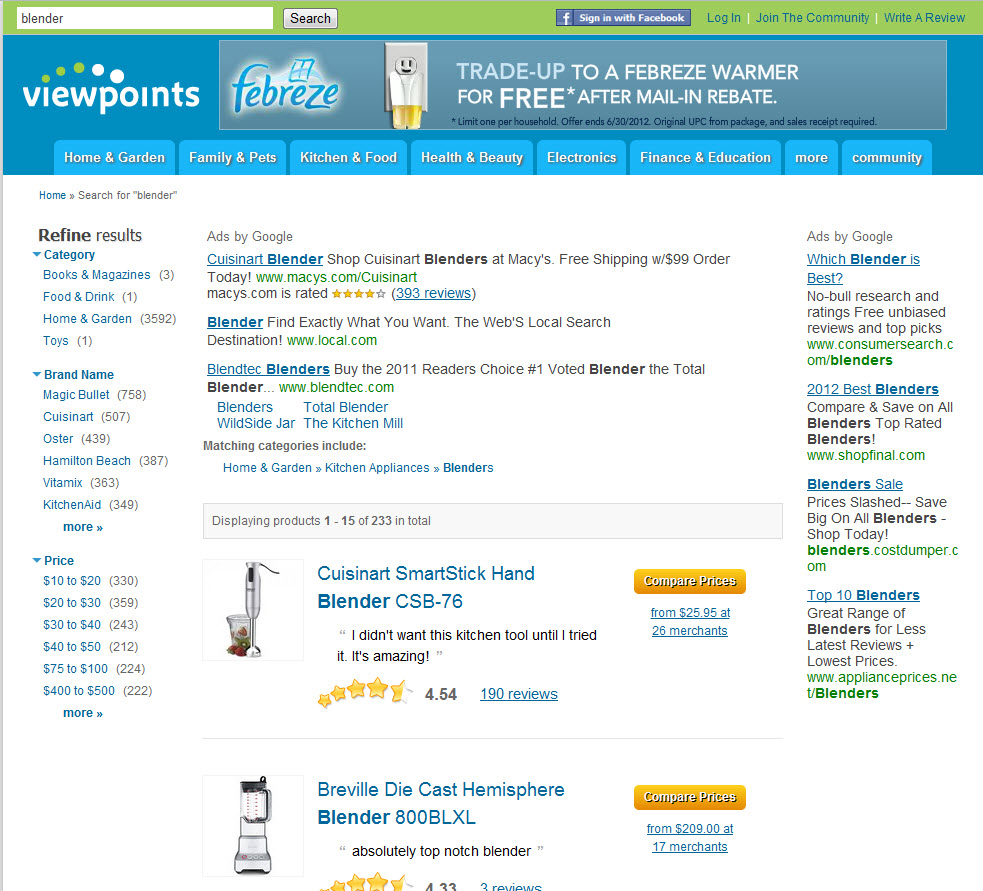
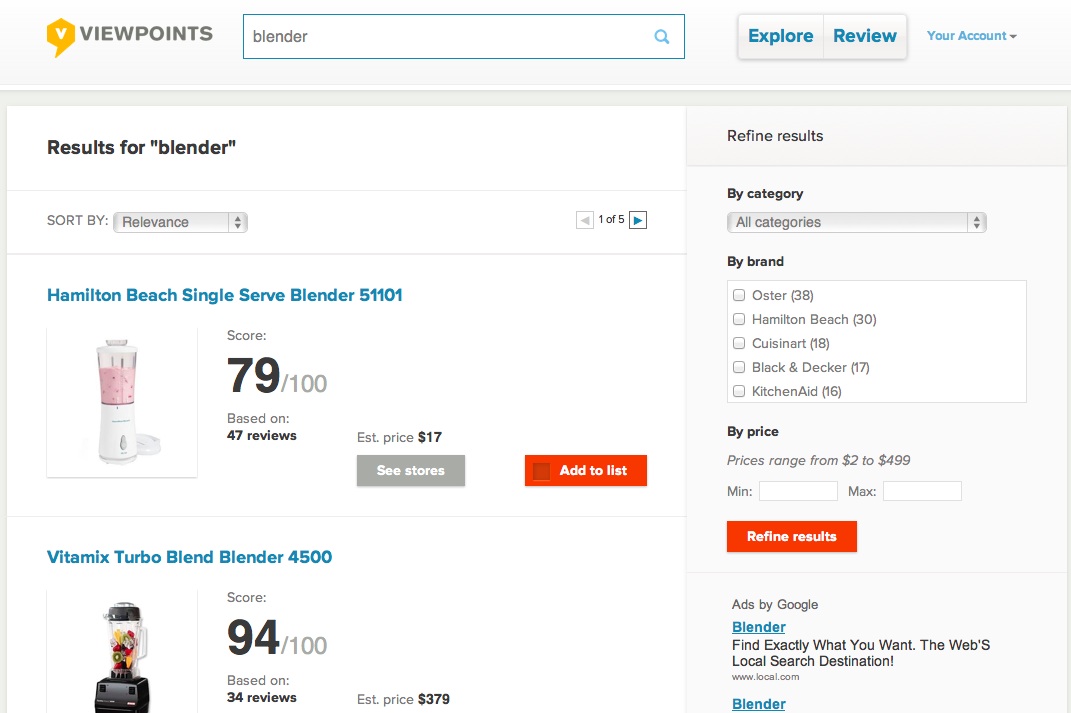
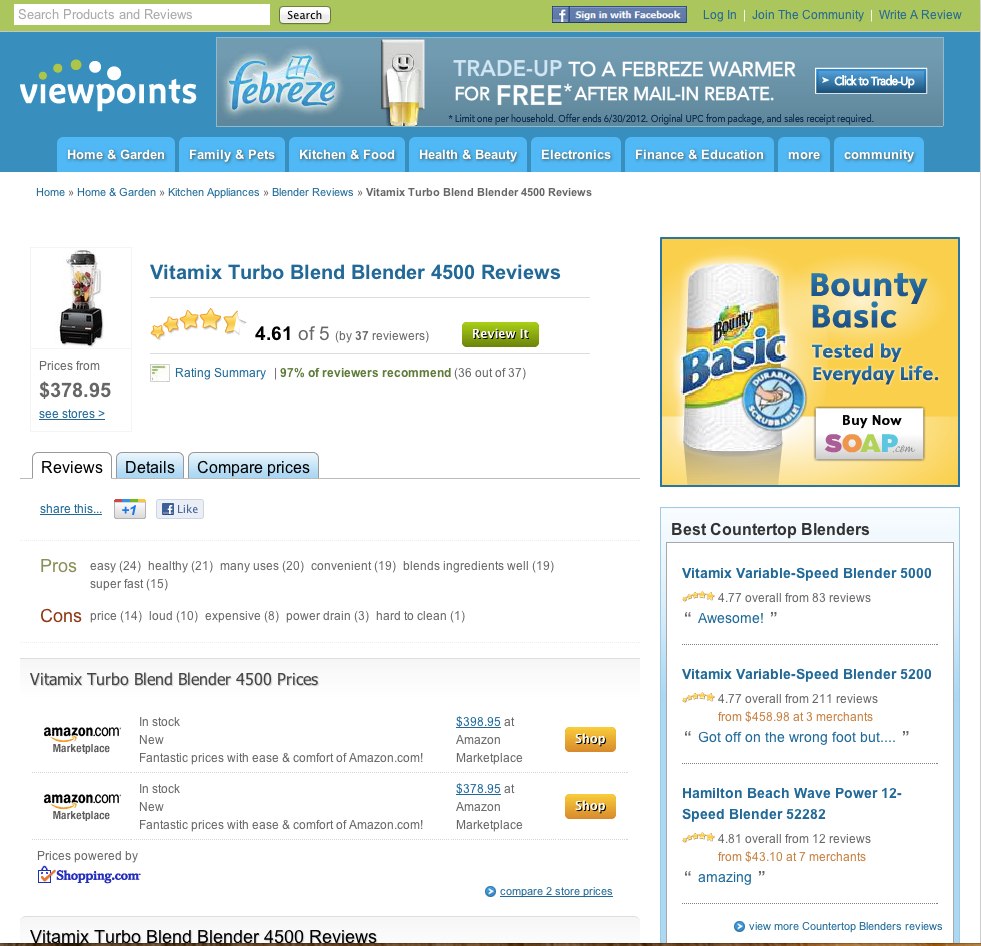
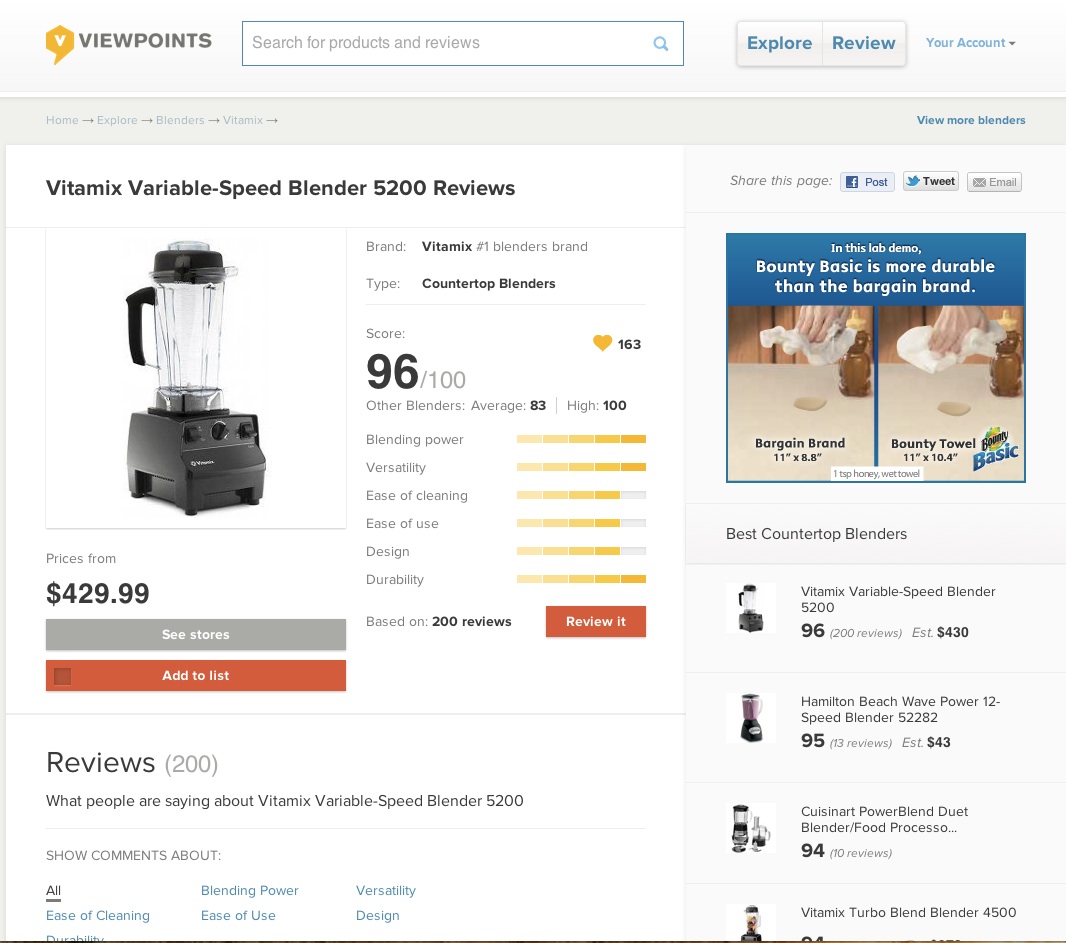
For Viewpoints, this meant cleaning up the content as outlined above as a first step, but it was also time for a redesign that was cleaner, simpler and better conveyed the credibility, quality and overall helpfulness of the site. In addition to eliminating 40% of the ads on the site, we also stripped out 15+ features that were clouding the core value proposition of consumer reviews and product rankings. For example, we made the decision to stop giving scores to products that did not have enough reviews. And we made it clear when members had connected their account to Facebook to demonstrate an extra layer of authenticity of the reviewer. You can see the following screen shots for some examples of the old design and the new.
OLD SEARCH RESULTS
NEW SEARCH RESULTS
OLD PRODUCT PAGE
NEW PRODUCT PAGE
Product Intelligence
So we have addressed content quality, site architecture and site credibility. But were we adding enough value to distinguish ourselves in a crowded market? Good question! While we firmly believe that getting the basics right (quality, credibility, ease of use etc) is the key to a great consumer reviews user experience, it became clear to us that there was another important way we could distinguish the Viewpoints user experience. We saw an opportunity to occupy the white space between expert reviews that make clear buy recommendations and the mass of consumer reviews which gave great consumer feedback but did not always help give a clear and concise buy recommendation.
We call this “Product Intelligence – for the consumer by the consumer“. We have spent a significant amount of time and resources developing scoring and ranking algorithms to smartly rank products against each other so that shoppers know what product to buy.
Diversification
As much as these changes were done to improve the user experience and in turn improve our rankings with Google, we also explicitly wanted to optimize mobile and social as two new channels that can be a new source of growing traffic to help us build our audience. The changes we made in these areas were very significant. The specific changes will be detailed in a later post.
Conclusion
So, that is how Google’s Panda update changed our business. It drove us to improve the quality of content, improve the credibility and trust of our experience and invest in Product Intelligence as a distinct point of difference in the market.
We don’t know how Google is going to respond to these changes but the important thing to note is that every change we made improved the experience for the user. So as disappointed as we were with the outcome of Panda, we will admit that it forced us to think harder about our business, about adding more value to the end user, and perhaps most importantly, take our game to another level. Game on.
09:04 0
Yammer Raises $85 Million In Funding

The money will specifically be used to hire more sales and engineering staff members and also improve advertising. It wouldn’t be a stretch to see Yammer using the money to acquire other, smaller start-ups in the space as well.
After tripling sales growth in 2011 the company has acquired a net total of 4 million users of their social networking service. The software is best described as Facebook for your company. Every employee has a profile and wall, and users are able to exchange ideas and stalk each other just like on Facebook. The home news feed is extremely useful in Yammer, and you can see what your colleagues are up to at a glance.
Yammer’s not alone, though. The space is heating up, and public company and competitor Jive recently announced their revenues had surged by 53% over the last quarter.
08:45 0
samedi 3 mars 2012
Google’s Plan To Compete With Apple’s Multi-Platform Siri? Google “Assistant”

In fact a multi-platform Siri could be unveiled as early as next week, when Apple announces the iPad 3.
Hardcore right? Well our friends over in Mountain View, never ones to miss out on an opportunity to compete, have come up with their own answer to Siri, Google ‘Assistant’ (earlier reports had it pegged as ‘Majel,‘ I have no idea whether that name was scrapped but do know that ‘Assistant’ is not a part of GoogleX as Majel was).
Google has had the in-house voice technology for ages — it hired Mike Cohen, the guy who started Nuance. But ‘Assistant’ is set to go beyond Siri in many ways, most importantly in that the search company will retain complete control of all the layers involved.
The project, helmed by the Android team with the involvement of search engineer Amit Singhal, has three parts according to a source.
1) Get the world’s knowledge into a format a computer can understand.
2) Create a personalization layer — Experiments like Google +1 and Google+ are Google’s way of gathering data on precisely how people interact with content.
3) Build a mobile, voice-centered “Do engine” (‘Assistant’) that’s less about returning search results and more about accomplishing real-life goals.
Unlike Apple with Siri, Google is planning on extending this service to developers so they can build novel things. Imagine the possibilities for apps, websites, etc interested in hooking into ‘Assistant’?
From what I know, Google has now set its ambitions beyond social and is focused wholeheartedly on building this “Do engine,” or goal oriented search: 2011 was the year of social for Google. 2012 is the year of ‘Assistant.’
According to one source, Google higher-ups plan on unveiling the ‘Assistant’ product by the fourth quarter of 2012, though they themselves are uncertain. Because our details are sparse for now, the fact that we might be missing a huge piece of this puzzle is also a possibility.
12:49 0
Non-Scientists Use Business Savvy to Launch Med-Tech Product

In 2005, the two Dallas friends were chatting about a friend who was pregnant. She had two girls already and really wanted a boy. An expectant mom can find out the gender of the fetus with the first sonogram, usually at about 18 weeks. But there's a curiosity gap between the first home pregnancy test and that sonogram.
"We said, 'Gosh, you would think there would be a way to tell by the urine whether it's a girl or a boy,'" Griffin says. "How cool would that be?"
Some Internet research turned up an interesting bit of folklore. In the 17th century, women had a fairly reliable test involving grains of wheat and barley. It piqued their interest enough to look for a lab that would work with them.
They were not scientists, but they did know business. Griffin was a partner in a commercial real estate firm. Garland was a business-development consultant for PwC. They called on friends and contacts for referrals.
The search took them to San Francisco, where they found a company known for its quality skin products. It had the expertise and the vision to help them.
"We were on a fast track to get a product developed," Griffin says. "We felt like speed to market was important. We couldn't believe no one had done this before."
In addition to developing a reliable test, the lab had to figure out which week of pregnancy would produce accurate results. It had to keep track of each sample and match it to the sonogram and the gender of the resulting baby.
The lab went down many dead ends, but the biggest challenge was getting enough of "solution," or the urine of pregnant women. It developed a special cup for the solution samples, plus all the packaging and directions.
The two women tried doctors' offices and approached women in malls and offered them $20 to pee in a cup. Finally, they spread the word through churches and schools. Many women began dropping off samples in the mailbox.
"We did a lot of brainstorming and whiteboarding," Garland says. "How do you find the right jar [for the kit]? How do you design your box? Do we need instructions? A syringe? It gets complicated."
Ironically, it took about nine months to create the IntelliGender test. Independent testing facilities have rated it 85 percent accurate.
Both women were still working full-time, investing their own money in the company when the product launched with Internet sales in 2006.
As the orders for the kit increased, with CVS and Walgreens carrying it, Garland and her husband went to work at IntelliGender in 2009 to manage the volume. Griffin kept her job but participated as a full partner in the LLC. The company expanded to Australia and then to 23 other countries.
The kit now retails for $35. The most expensive part of the kit is the syringe for dropping a sample onto the tester—it was the only imported item. To date, the company has sold more than 500,000 kits worldwide.
IntelliGender also sells IntelliCeuticals, natural remedies to support the health of pregnant women and babies. The company aims to bring more complementary products to market.
Looking back, Garland thinks that the partners' business expertise more than made up for their lack of scientific training.
"We both had marketing [experience]. Rebecca had contract negotiations and I had finance and consulting. My husband was IT, manufacturing and logistics," she says. "A lot of inventors have the opposite scenario.
"But if you spend your whole time in the lab, you have no exposure to business. I think that was key to our success. We had the background of how to make it happen."
Griffin agrees. "You can outsource anything you need," she says. "In fact, it's highly unusual that anyone would have all the skill sets you need to develop a product. Tenacity and ambition are the mothers of invention."
Photo credit: Courtesy subject
12:40 0
Bringing Luxury to the Masses

It’s called Gilt Groupe, and it's a members-only e-commerce site that offers merchandise like women's sweaters, men's socks, kids' booties and home decorations—all at price points that don’t induce fainting spells. The best part: The site boasts wares from runway designers such as Zac Posen, Carolina Herrera and Valentino, to name a few.
Friends and fellow Harvard MBAs Alexis Maybank, 37, and Alexandra Wilkis Wilson, 35, launched Gilt Groupe in 2007 as a way to bring the New York City sample sale to the masses. The caveat: Those who wanted in had to be invited (today you can ask to be invited), thereby increasing the exclusivity and excitement around the venture. The plan worked beautifully, and today the business boasts $500 million in revenues, more than 900 employees and offices around the world. This year the duo will release a book documenting the company’s meteoric rise, titled By Invitation Only: How We Built Gilt and Changed How Millions of People Shop.
We got in touch with Maybank and Wilkis Wilson to find out how they managed to successfully change an entire industry.
Could you tell me about your backgrounds?
Alexis Maybank (pictured, right): I grew up between Charleston and central New Jersey. I met Alexis while at Harvard undergrad in a Portuguese class. We were a couple years apart and became great friends. After college I worked in Silicon Valley through the first wave of the technology boom. I was an early employee at eBay, when there were just 40 people. We both ended up going to business school at Harvard. While there, I did an independent study with Zac Posen.
Alexandra Wilkis Wilson (pictured, left): I grew up in New York City and after school worked in investment banking in London for a few years. After business school, I switched gears into retail and luxury goods and worked for Bulgari.
How did you come up with the idea for Gilt Groupe?
AM: In 2007, I was coming off an opportunity, and Alexandra was ready for a new challenge. We would often go to sample sales and had family members from around the country that would ask us to pick up items for them. Sample sales really weren’t available to people outside the tri-state area, so it dawned on us to think of a way to bring those sales to a mass-market audience. We started meeting and talking about how to launch the perfect concept.
AWW: Alexis started working on the site full time, and I stayed at Bulgari for a little while longer. She managed the building of the site while I started reaching out to brands.
How were you able to secure funding?
AM: We started talking with VCs about three weeks before we launched and were successful with AlleyCorp, a group started by Kevin Ryan, one of our co-founders. Dwight Merriman, the founder of DoubleClick, was also able to help us. That funding provided us enough to hire a few employees and rent office space.
When did you launch?
AWW: We consider Nov. 13, 2007, our official launch date because that was the day of our first sale, a Zac Posen sale. Two weeks prior, we did a membership launch where we teed up thousands of e-mail addresses to invite them to join Gilt Groupe.
How many members signed up out the gate?
AWW: We got over 13,000 members to sign up, but we didn’t know if that was a good number or not. We were trying to aim even higher and encouraged friends to invite friends with the incentive of a $25 credit.
What challenges did you face starting out?
AM: One of the first challenges was building a team. After two months we realized that we were hiring people just like ourselves, bright-eyed optimists. It didn’t make for a balanced team so we brought in executive coaches to help. About five months in, we hired an excellent woman out of Ralph Lauren. She brought a really measured approach to the business and made decisions based on experience and facts and not as much on intuition.
We also focused a lot on open communication. Seeds of distress can really tear apart startup teams when they aren’t addressed, so we made communication a priority.
How did you survive the recession only a year after your launch?
AWW: While the recession was a terrible thing, it ended up actually helping our business. Many brands were dealing with excess inventory and having a hard time selling things at full price. Plus, a lot of customers still wanted to shop for designer goods but didn’t want to walk around with big shopping bags; they wanted to be discreet. We ended up growing our membership faster than forecasted during that time.
How are you able to offer such slashed prices?
AM: There are two things that help us with pricing. First, we don’t have overhead or pay rent on Fifth Avenue. Second, we work in an industry that has seasonal inventory, so things need to turn over.
What does the future hold for both of you and for Gilt Groupe?
AM: We’ve talked about taking the company public, but at the same time don’t want to lose sight of providing the best possible customer experience. We will discuss the option of going public this year. [Wilkis Wilson reports the company received a $1 billion valuation in spring 2010.]
I love Gilt and couldn’t think of a business I’m more loyal to. I’m happy right now and just had a baby boy two weeks ago. I also have an 18-month-old daughter at home, so raising a family is a big part of my future plans, as is continuing to be involved heavily with Gilt Groupe.
AWW: I really enjoy mentoring young entrepreneurs and am now a mentor at TechStars. As for my future, I love Gilt so much and am still personally learning.
Could you tell me about your book?
AWW: The book is coming out in April, and it really focuses on our early days, getting the company off the ground. We worked on it for about two years, meeting every Thursday at 8 a.m. to brainstorm and go through anecdotes. We are really proud of the final product and hope it inspires other entrepreneurs.
What advice can you give budding entrepreneurs?
AM: Figure out if now is the right time to launch your company. Who is doing it already? If there isn’t anyone doing it, is there a reason why?
Also, execution is so much more important than the idea itself. Get your product out there and get feedback from your customers. The earlier you can get feedback, the better. Don’t over-invest before you know more from your customer base.
AWW: You really need to trust the people you go into business with. If you have any red flags or don’t know the person well, pay attention. It is easy to get sucked in by excitement and adrenaline. Invest time in reference checks.
If you are starting a business and throwing out ideas to consumers and investors, it is important to listen to criticism. That doesn’t mean you should back down on your ideas, but take that feedback to heart and think of how you can apply what people are saying to your business model.
Photo credit: Courtesy company
08:50 0
vendredi 2 mars 2012
5 Things Women Should Never Say When Negotiating

Women with children make even less, according to the National Committee on Pay Equity. A recent University of New Mexico study shows moms earn 14 percent less than women without children.
I hesitate to blame the victims, but women need to stand up for themselves when they are negotiating. Research shows that women negotiate as well as men do when they are arguing for other people, not for themselves, says Victoria Pynchon (pictured).
“They aren’t bad negotiators, but they have been enculturated not to ask for things for themselves,” says Pynchon, co-founder of She Negotiates Sales and Training, a consultancy based in Los Angeles. “They hesitate, and when they do go out on a limb, they often are on the receiving end of cultural blowback.”
This cultural consequence can come in many forms. When people step out of cultural roles, others become uncomfortable and often show disregard or express anger, she explains. So, women accept unfavorable conditions and may even bypass negotiating altogether.
“The biggest mistake women make is to not negotiate at all,” Pynchon says. “They are happy to have a job and they don’t recognize that they have an opportunity to help shape the terms. Because we tend to compare our income to the income of our women friends, we are all operating at a level of wage gap.”
How can you negotiate better terms for yourself and thereby help close the gender wage gap? Start by staying away from the following phrases.
I’m sorry
Women tend to apologize for things they shouldn’t. Apologizing in the negotiating room lessens the weight of your argument. Stay away from saying things like, "I’m sorry to ask for this, but I feel that I deserve a raise."
Don't discount your worth right out of the gate with language like, "My rate is $5,000. I know that's a lot, so I’m willing to take 20 percent off for you."
“Just stop apologizing, period,” Pynchon adds. “You are already being valued less because you are a woman. Be confident.”
What if you receive blowback?
“Say, ‘I’m surprised that you would pay me anything less than market value,’” Pynchon says. “Don’t get mad back at them, just be measured and direct the conversation to a resolution.”
I feel
It may be second nature to express how you feel about a topic, but those words need to be kept out of negotiations, according to Beverly D. Flaxington, co-founder of The Collaborative, a business consultancy in Medfield, Mass.
“Most negotiations are about facts, data and information. Once you talk about feelings, you lose credibility,” she says. “Asking the other person how they feel can be off-putting. Why are you trying to understand what’s underneath their actions?”
OK (at first offer)
Pynchon instructs her clients to always make the first proposal. If the hiring representative says no to your proposal, respond with questions.
“Say, ‘what about this offer is not palatable to you?’ she says. “Start high or low enough to permit them to make at least three concessions.”
I never thought of that
Do your research pre-negotiation. If, during the process, the opposing party presents something surprising (or outright shocking), maintain composure, advises Alan Guinn, managing director and CEO of The Guinn Consultancy Group in Bristol, Tenn.
“Then walk away from the table, do your research and come back,” he says. “Always let the other side of the negotiation assume that you know everything about a topic.”
No
The point of a negotiation is to “drive the conversation to an agreement,” says Pynchon. Saying ‘no’ closes off the conversation and makes it difficult to start back up.
Pynchon offers an example: Your hourly fee is $350 but a potential client tells you he can only pay $200 per hour. Instead of saying no, ask "Why it is you can’t pay more than $200 for this service?" Or, try something like this: "Having talked about my services, I think that I will benefit your company in X ways. What is it about this figure that is [difficult] for you?"
Continue the conversation with phrases such as "I hear what you are saying," and "Tell me something about that."
She says, “It's all about active listening and trust building.”
12:19 0
Inscription à :
Articles (Atom)


